Sunday, February 28, 2016

Authentic Listening

One of the goals of any great language program is for the students to develop an ability to listen to and understand the native voice. This is a skill building activity that occurs over time with numerous interactions with a variety of speakers in different contexts.

In my Spanish IV class, students jump on the elevator of listening starting at the ground floor. While this is something that is scaffold, starting in the lowest levels, it truly is like getting on an elevator: The elevator goes up (skill building), pauses at floors (plateaus), continues up (with additional, deeper skills), and sometimes goes down a level or two before proceeding up again.

Some of the first voices they hear are from cartoons and children's TV shows, such as Pocoyo and Fifi y los floreguitos, easily found online shows. This is meant to be easy as it usually involves simplified speech with lots of visuals to aid comprehension. This moves to a baseball game commentated by natives with some Spanglish. Eventually students are watching news reports, some of the fastest speech out there, and comprehending.


To assist in comprehension, students don't simply listen and *poof* they are great listeners. There are scaffolding activities that happen. For example, in the baseball video, students have a guiding worksheet of items they are looking for while watching. Some of these include listening to the speech of the commentators, but others include nonverbals like identifying the names of products on the signs in the outfield.

This particular guiding worksheet prioritizes what they are looking for as they listen to the video. Some teachers could use this for standards-based grading, but I prefer to use it more as a personal challenge for the students. The top part is obligatory - everyone must get those, then the English words that are used. Finally, at the bottom, are a list of words that are the biggest challenge and require deep listening to the commentators and commercials.

The first time students hear the native voice, it can be a very intimidating experience. However, I explain to them the analogy of a ceiling fan. When you first look at it spinning on high, it appears to be a large disk. If you continue to watch it, you eventually see that there are blades and not one solid disk going around. With additional concentration, one can pick out and follow an individual blade all the way around, without adjusting the speed of the fan. This is all true of language, too. At first it just sounds like one big word and they're all talking way too fast. However, after some training of your ears, you will start to pick out individual words. Eventually, you will begin to hear full phrases and be able to communicate with other people.

As we all know, this is not an overnight process and it takes time and intentional effort to make it happen. Small steps and guided activities such as these can make a big difference in building confidence with students.

Friday, February 19, 2016

SNOW BALL FIGHT!!

We were on a shortened schedule this week due to conferences so we had to push quickly through the reading activity today. Fortunately it was a short and easy chapter for them with not a lot of events that took place.

Goal: I can understand an authentic text that I read.

Two new characters were introduced in this chapter, but we were able to easily understand their role due to previously analyzed events that led up to this point. To begin, we discussed the new characters:
1) Coronel Antonio Cordero Negro
2) Sargento Ignacio Florido Peña
3) Operación Revelación

After a brief discussion and review of each character and the plan, students found a partner and received a piece of paper. They were given a number that corresponded to a character. With their partner, they wrote a characteristic of that person/plan. They crumpled the paper into a "snowball" and threw it to someone else, creating a snowball fight.


After a few seconds, they opened a snowball, read it, and added to the list. No duplicates were allowed. It was possible they got a paper with the same title they already had or even their same  paper back. This is where the repetitions come in, being able to see what other people wrote. The writing/fight pattern continued about five times.


On the last catch, the students opened their "snowball" and completed a minimum of 8 characteristics for the paper they had and included their names. The snowballs were tossed into a basket for me to review and a final brief discussion summed up the lesson.


Valentine's Poetry

In Spanish IV we have a day each week that we focus on developing writing skills. For Valentine's Day, or close to it, I like to have the students do an alternative activity in which they write poetry. It's a nice break to the usual routine while continuing to develop their writing skills.

Goal:
I can write on a variety of topics.

Part 1: flores
Each student receives a flower as she enters the room. Students are directed to pluck each petal, one by one, reciting the stream of "he loves me; he loves me not".


Part 2: poesía
Students receive a list of the structures for their poetry. They practice these, using the different tenses, creating 3-5 poems. Some students will write about a loved one, a pet, or even a thing that they love such as pizza or desserts.


Part 3: Valentines
Finally, they will create and decorate their own valentines with the poetry that they wrote. These are then displayed in the classroom.


Here is the end result of the valentine poetry writings.


Saturday, February 6, 2016

Learning to Read vs Reading to Learn

This semester I have a pretty awesome group of Spanish IV students. I wanted to push them and really assess their reading comprehension. The only variable I can't monitor is if they are using a translator to assist them, or worse, do the work for them, because really, what are they learning from that?

What are they really demonstrating?
Typically we read the novel together, but I wanted to see what they really understood and not what they pick up from our discussion of each chapter. So what I'm doing this semester is having the students read a chapter independently and then coming to class prepared to discuss it. The first thing we do is take a quiz over the chapter, usually 5-10 questions over the main ideas of the chapter to assess what they are understanding when they read. Then they have a group activity to discuss it and fill in any gaps in their understanding of the details and the cultural themes.

Chapter 1
My goal is to have a different activity for each chapter we read. The first chapter usually establishes the setting and the characters so we read that together as a class to give context for chapter 2. The next two chapters we have been using the routine as listed above.

Chapter 2
Chapter 2 of La hija del sastre we did a group acting activity. [A friend asked for an example of an AIW activity so this provides a very detailed description of what we did.]

Chapter 3
For chapter 3, I typed out the chapter and put it into 6 different wordles. The students were in groups and had to circle 4 different words with their partner.
Then, collaboratively explain what was happening in the chapter with that word. Each word needed:
- 5-8 descriptions
- evidence from the chapter
- focus on importance of word in chapter
- no repeats when presenting

We practiced this as I modeled the word "soldados". I intentionally chose the largest word in the word cloud, knowing that many groups would choose that and it would be easiest for them to practice. The potentially most difficult part of this activity was the last part in which they couldn't repeat any word from the word cloud.  As the 12 groups presented, I wrote the word on the board so we could keep track of what was used.

Learn to read vs read to learn
Just like in elementary school students learn to read, but in middle school they read to learn. As language teachers there comes a point where we no longer have to teach words that they need to communicate; we can indirectly teach them the necessary vocabulary through reading and conversation.

Gracias
Thanks to Carrie and Carol for their great work in writing this novel. The students have been enjoying it so far.


Wednesday, February 3, 2016

Registration Memes

With the upcoming 2016-2017 course registration next week, I jumped on the bandwagon and decided to make some interesting memes to get kids excited about and remember to register for language courses next year. This is subliminal advertising, suggestive selling, passive aggressive, number-boosting tactics, smart marketing, whatever you want to call it. Here's what I came up with. These are my creations, except the first one (inspired by Martina Bex), so I give you full permission to use them however you'd like.


Tuesday, January 26, 2016

Family

A reader asked me to post about teaching family. I like to use famous people and make a fictitious family because I do not know all the social relationships and I could easily offend someone making them part of the family or not. Also, being a TPRS/CI teacher, it has to be comprehensible and all in the target language. Those of you who are familiar with TPRS/CI, this is a variation of ask-a-story.

By the time I get to this part of the lesson, the students know a sufficient amount of descriptive vocabulary and some very basic family words. This makes the first part review and we slow it down when getting into more detailed family members. One of my goals for this lesson is to focus on the N de N method of possession: la hija de Michelle.

Start small and work towards more complex. As stated earlier, students already know these words so it is merely review and accessing their background knowledge. TPRS involves lots of questioning using comprehensible input. So, I will start off with...

[pointing to Barack] "Clase, ¿Es Barack un hombre o una mujer?" Sí, es un hombre. [We can then briefly describe Barack] "Clase, ¿Tiene Barack un esposo?" No, Barack no tiene esposo. Barack tiene una esposa. "¿Cómo se llama la esposa de Barack?" Sí, la esposa de Barack se llama Michelle. "¿Es Barack un esposo o una esposa de Michelle?" Sí, Barack es un esposo; es el esposo de Michelle. This line of questions will continue until I feel most of the class is comfortable with these words. Then we go to the next picture...

It's interesting that some students don't realize that Barack and Michelle are from the previous picture so I will make a few quick questions again about their relationship. Then I add in questions for "hijas":

"Clase, ¿Quién es la esposa de Barack, Malia o Michelle?" Sí, Michelle es la esposa de Barack. "¿Michelle y Barack tienen hijos o hijas?" Sí, tienen hijas. "¿Cómo se llaman las hijas de Michelle?" Sí, las hijas de Michelle se llaman Malia y Sasha. "¿Cómo se llaman las hijas de Barack?" Sí las hijas de Barack se llaman Malia y Sasha. "¿Es Malia un hijo o una hija de Barack?" Sí Malia es la hija de Barack. This questioning continues until I feel most of the class is comfortable with these words. I may ask them to turn to a partner and use the words "esposo, padre, hijo", or forms of the words, to describe the First Family.

This is the point where obviously it is no longer an accurate family tree for the Obamas. This is where TPRS becomes really fun! The above line of questions continues for this vocabulary. In this diagram, Beyonce is the sister to Barack and Bill is the brother to Michelle. Once they start to get comfortable with the vocabulary, you can add in any additional details or descriptions that you have been working on to start to create a storyline for the family. The crazier the better is what TPRS is all about. Be sure to return to earlier vocabulary to continue circling the information and get more aural repetitions. I like to pretend I'm getting confused and say things like Barack is married to Beyonce so that they have to correct me, or that Sasha is the sister of Bill.

A basic storyline has ensued and now we have additional family members. Whenever a new set of vocabulary is introduced, be sure to circle the relationships using the N de N possession as much as possible. In this diagram, Morgan and Diana are the parents of Barack and Beyonce. However, Michelle and Bill's parents have already passed. Yes, this makes for an interesting plot twist to the story. Reasons for their passing can become very comical, especially given that they are talking about the First Family. Sometimes I will include "in-laws" if I have a particularly advanced group of kids that need the challenge. Other times I feel accomplished to just get the basics done.

The final vocabulary has come. Gary is the son of Bill, the cousin of Malia and Sasha, and if you want, the nephew of Barack and Michelle. Gary, el primo, is the final family to be added so he is the one that resolves the problem presented in the story created.

Now that you have a quasi-complete family tree, you can easily review the vocabulary from today, including the N de N possession. Kids will remember the details of this diagram, including the vocabulary, because it is so bizarre and interesting to them.

For an assessment, simply giving them this family tree and having them explain it without the use of the vocabulary in view is a great way to have them show what they know. Asking them questions (orally or in writing) about the family tree is another way. Doing a quick write or a proficiency write looking just at the family tree will also provide you with a valid assessment.

Obviously any vocabulary you wanted to include could be substituted, along with other grammatical structures and people.

Sunday, January 17, 2016

Café y conversación

When reflecting on our own personal language studies, what is the number one activity that helped us learn the most? Of course: speaking and living in the native environment. So, isn't it logical that we try to bring that to our students who can't or won't travel abroad? or at minimum simulate this environment?

Why?
I find random conversation one way to help hook students into learning. When we have authentic conversation about topics that students want to talk about, they ask better questions and learn at a higher level. This is why it is so important to put students in this situation. When they will need to use the skills we are teaching them, it will likely be speaking first. Culturally, Hispanics love to talk; they will sit around at lunch for a couple hours and just socialize, they will meet someone new and talk for an extended amount of time. This creates a perfect bonding time for the students to create their own culture and safe place in class.


When?
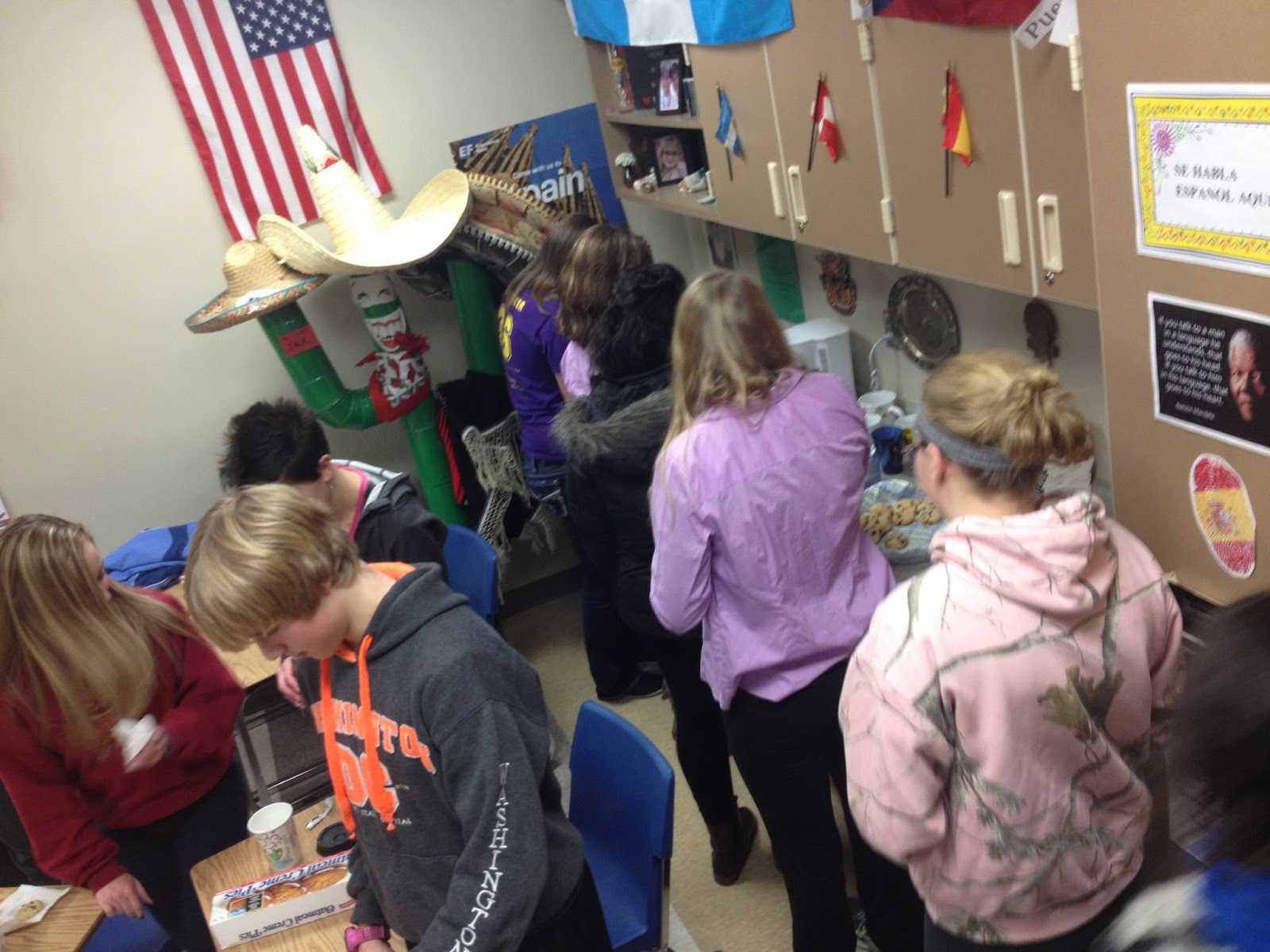
Living in the midwest, we see days that Mother Nature wreaks havoc on our roads so school is delayed or cancelled. These are obviously not planned so all of a sudden our schedule is interrupted and lesson plans need to be changed. This is when I call a "Día de Chocolate".

Preparation
My room is always supplied with cocoa (complete with marshmallows), cappuccino, tea, and cider. There is also a coffee pot that has only ever seen water. I
replenish the supplies as needed and on our Días de Chocolate, I will bring in cookies, cinnamon rolls, bars, or some other treat as well. Often times students will bring in treats. Due to many schools having treat policies, the students usually bring in prepackaged treats, but I accept any treats anyone wants to make. This year I do have a couple students who are on a gluten-free diet so I prepare an alternative. The students choose to eat/drink; I never force or require anything.

Notification
I am also an avid weather watcher so I know days ahead if there is weather coming. I will warn students if it's obvious that there may be a late start. "Yeah, guys I hear tomorrow there is bad weather coming. Remember if we have a late start, it's a Hot Chocolate Day! This means you have to bring a mug and be willing to chat." When the call is made from the superintendent and/or we see it on TV, I send out a message to the students that it is officially a "Día de Chocolate".

Hot Cocoa Day
Most students do indeed bring their mug, but I do have a small selection of mugs for students to use as long as they wash it and return it before the end of class. Upon entering, I remind them that it's Hot Cocoa Day so they go to the counter, sanitize their hands, and prepare their beverage and snack. The desks are arranged in a circle to be more conducive to conversation. I will start the conversation off with small talk about what they did this morning with their extra two hours, how the drive in was, what they saw (cars in the ditch, etc), and other particular details of their morning. Once you get them talking, they will bring up other topics and the conversation continues throughout the class period. Some groups are more chatty than others, but I have never had a group that would just sit there and say nothing. The culture is created on day one that the expectation is 100% Spanish. They know that in order to improve their skills, they need to speak the language.

Reflection 
Students really do improve and they really do start asking good questions.
In the end, this is a favorite activity of nearly all students.

Student comments
In an end-of-the-course evaluation, these were a handful of the comments I received from students about what they enjoyed the most about the class.

"Keep the same open environment. I was never embarrassed to say an announcement or talk out loud in class because I knew that she would help me if I needed it."
"She should keep having hot chocolate days and bringing in treats!"
"To apply food into the class it makes learning delicious."
"I liked that your teaching style was less serious but still made us get the work done that we needed to so that mind set was nice."
"When we got in a circle and just talked in Spanish for the whole day."
"I can't think of a favorite because I liked almost everything we did in this class. I enjoyed listening to the songs, reading the books, learning tons of new vocab and eating chocolate and having fun."
"The locked box game or having hot chocolate days and talking."

Saturday, January 16, 2016

Slap Jack

Remember the good ole days of playing slap jack with your best friend? This led to a game to distinguish the present and past tenses, something they have been struggling with in class.

1) Students receive a pack of cards that have different forms of present and past-tense verbs. One student flips the top card.
2) If it reveals a past tense form, they slap it.
3) Before earning the card, the recipient would have to translate it using the correct form and tense of the word shown. If the partner agrees with the translation, he takes all cards.

For example, here are the cards revealed:
1) estaba slapped, translated, and won
2) es nothing done
3) van nothing done
4) fui  slapped, translated, and won last 3 cards (es, va, fui)

The student with the most cards at the end, wins!

This activity could be expanded to a writing activity or even a speaking activity.

Writing: Students choose 5 of the verbs that they "won" and create an original story using them, similar to a quickwrite or a proficiency write.

Speaking: Using their cards, create a progressive story. One student begins by using their card to create the first sentence. The partner creates the second sentence. The story continues as they use their cards. Once out of cards, the student creates their own sentences to continue the story until both partners finish using their cards.

Sunday, January 10, 2016

Peer Editing

This past week, the end of a grading period and the end of the course, students have been preparing a movie version of a novel we have been reading in class. One thing that I wanted them to be able to do is become more aware of errors that they are making. One way to do this is to be able to recognize and correct errors in their writing.

Since this is a multiday project that they are working on, they need to be able to self-pace. I developed a form for them to complete each day. This helps them identify their successes for the day and also their plan for tomorrow.

Once the script was written, each student had to choose two peers to help them edit their script. This is not the traditional way that I have done peer edits, but I really like this. It makes them focus on the type of errors they are making, not the individual errors. They focus on tenses, vocabulary, and sentence structure.

What I really liked about this is what is shown in the photo to the left. Students really started analyzing the scripts. They started to ask great questions of the person who wrote it. They started to ask great questions of the person who analyzed their script. They started to really look at their writing and how to improve it.

I can't wait to see the final edits at the end of this week!

Wednesday, December 30, 2015

BreakoutEDU

Recently we had a PD day in which we were assigned to a room with our colleagues. My particular room assignment was facilitated by our principal. He told us a story of a professor who was trying to kill everyone off, but had a serum that would save himself. He kept it locked in a box (at the front of the room) and had left clues in the room about how to open the three locks. Our job was to find these clues, open the locks so that we could "breakout" of the room. We had 45 minutes and could use anything at our disposal, including electronic devices.

That was my first encounter with BreakoutEDU. The more I reflected on it, the more I thought I could recreate this in my language classroom. To make it even more interesting and challenging, I could have TWO boxes with different clues, thus two different teams in the same room trying to find and open different boxes, not knowing if the clue they found was really intended for their box or the other box. mooohahaha

We had just finished reading ¡Viva el toro! in Spanish III so this would be great. There was so much information about bullfighting as well as other cultural tidbits we explore at various degrees of intensity throughout the book. Knowing that the students had to use different skills to solve the problem than it usually took to have a discussion in class, this was about to get real interesting! Some of the locks were numbers; others were words. I really thought box 2 was more difficult.

Out of the 3 groups, only one group was able to breakout. It was interesting to watch the students work in this different capacity. Another group wanted to keep trying to figure out the clues, just to open the box. The challenge was greater than the prize for them.

I learned a lot about myself as well. As a teacher, I really want to see my students succeed and feel success along the journey. It was really hard to not give them free hints along the way. I had to wait for them to turn in one of their two hint cards. Sometimes they got fixated on an object that had nothing to do with the clue or be so close to solving it, but just couldn't get it, even when it starred them in the face. Taking a back seat is really really hard for me. I wanted to push them in the right direction and guide their journey, rather than let them discover and explore. It's too bad our schedule is dictated by minutes and hours. It's a necessary evil, however.


These were the two boxes, the combination, and the clues to find the correct combinations to unlock the box. It was a great day in class and we all learned.
Box 1
Lock: Clue:
TOROS “seven arrive, but only one leaves” <black light written on bullfight picture on bulletin board
496 bit.ly/secuestradora
41001 address to the bullfight arena
Screen Shot 2015-12-20 at 8.27.48 AM.png


Box 2
Lock: Clue:
ARTE- “The clue is in the view, Julio.” <black light written on bullfight picture on bulletin board
490 bit.ly/secuestrador
56978 km > miles river basin


Copy of the letter that the "secuestradora" sent to Julio. Some letters are changed to purple, which spell out a bit.ly link to another clue.

Julio,

Tenemos tu novia, Ana.
Todo está bien, pero necesitamos dinero.
Nos reunimos en Sevilla a la Plaza de toros a las dos de la tarde.
El paseíllo revela dónde está tu querida.
Cuando nos reunimos, podrán tomarla y estar con ella nuevamente.
Sinceramente,
La secuestradora