In preparing for a sub, and after much repetition, conversation, and practice, my students need a fresh way to review and use their grammar. Students need and embrace choice in transforming the information into something new, without me there to guide them. Below is a list of ideas I came up with for them to practice their weather expressions. We regularly discuss what they are learning, how they are learning it, and what they need to be successful. I tried to tap into the various learning styles of my students, their interests within the classroom, and what they have expressed as positive ways to increase their learning. In about 10 minutes, I was able to brainstorm 15 activities! wow. In the end I am only choosing to offer six of these choices. Perhaps later in the week when we start forecasting weather I will mix it up with six new activities from the list. Here is the result of my planning, discussions with students, and weekend work. To see some student examples, search the twitter hashtag #shspn1 Monday morning. If you want to see any of the materials, let me know and I would be very willing to share them. Please share any other ideas or variations on these that you use in your classroom.
Learning Centers – weather
1. Vocab wheel “Wagon Wheel Wonders”
This is an activity from a strategy called Vocabulary Wheel. Sometimes students forget that sentences are really groups of words that are put together. This strategy will help them form sentences and put those sentences together to form a paragraph. It serves as a stepping stone to independent writing and also builds confidence. Students will choose a word from each wagon wheel to create their wonderful sentences. Post 3 to twitter. Don’t forget the class hashtag.
Wagon Wheel #1: seasons
Wagon Wheel #2: weather expressions
Wagon Wheel #3: temperatures
Wagon Wheel #4: days of the week
2. crossword
This is your basic crossword puzzle I created from puzzlemaker.com, but it really addresses the logical/mathematical learners. Students will translate the words and phrases from English to Spanish to complete the crossword. It includes both vocabulary and grammatical expressions. Be careful with your spelling or your words may not fit correctly!
3. blog – describe pictures and post in blog
We have been using the 4 questions in class to describe seasonal pictures. Add any additional information can be added to complete the story. These are the questions:
¿Qué tiempo hace? ¿Cuál es la estación? ¿Cuál es la temperatura? ¿Qué hace en el tiempo?
4. Vocab and grammar practice website.
I maintain a classroom website that has podcasts, tutorials, and other classroom links on it. This particular link will take them to learning games created on quia.com Thanks to all the wonderful teachers for making their work public!
5. Pattern puzzles
This is a strategy that helps students organize and categorize information, as well as notice patterns. It again address the logical/mathematical learner. It's a great way to get students to transform the information they just learned. It's like putting together a puzzle, thus the name. Proficient learners recognize that there are patterns of information in content. This strategy can be used to review learning or, from a constructivist point of view, be used to teach new concepts. Using the seasonal pictures in the envelopes, student match strips of paper with the weather expressions with the appropriate picture.
6. Calendar/stories
In an attempt to make an activity more authentic in nature as well as utilize the technology that they have at their fingertips, they will be looking at the iCal image and explain the weather and activities as reported on the calendar. These ministories will then be posted to twitter.
7. Ta ta ti – aka tic tac toe, a speaking/listening activity
In groups of 2, one student has a card with a 2x4 table and simple weather pictures in each cell. For example a sun or a cloud or a rain drop would be used. The student with the card does not show the second student, but rather describes the weather in the picture. The second student draws the pictures that are described, in the order described, on his/her paper. The card and the drawings are then compared for accuracy at the end. The drawer will take a picture of both the card and the picture drawn and post to twitter.
8. Happy/sad
This is another speaking/listening activity for my verbal kids. Read a weather description and a situation. These could be prewritten or the students can make them up on the spot (one way to differentiate!) Partner holds up a happy card or sad face card, depending on how the character feels.
9. 4-square
This strategy is also called a “Magnet Summary”. Using an index card (or a 2x2 table), identify the topic (season) and write it in the center. Each corner serves as a magnet to that topic. So, in one corner write 3 types of weather; in another, 3 times; in a third, 3 activities; in the fourth, 3 temperatures. Students will then create sentences to explain that season using one item from each magnet. For example, “En el verano, hace mucho calor. La temperatura es 84 grados. A las ocho y media mis amigos practican el béisbol.”
10. poetry writing
Poetry can be anything we make it. There are rules to poetry, and then there are no rules. It can rhyme, or not rhyme at all. It can be restrictive or a totally open, free-flowing, mindstreaming. It can have a structural pattern or the words can form a picture. Poetry is the most versatile style of writing. We are only limited by our own creativity! Students use their vocabulary and grammar to create a poem about weather, the seasons, or temperatures.
11. 8-page book http://www.cccoe.net/tales/folded_book_final_1.pdf
This is another one for my kids that need manipulatives. Create an 8-page book, choose a weather expression to write at the top of each page, and then draw a picture for each one. Be sure to state the temperature, season, and what you can you in each type of weather reported. Share it with at least 3 other students and have them sign the back of the book. Their signature means that they have read it and agree with the grammatical structures and use of the vocabulary. This is a great way to get peer tutoring/editing and also reciprocal teaching.
12. Peek-a-boo
Our Elementary Booster Club purchased a die-cut machine and so I asked permission to use it to create some 9-tab window die-cuts. I put weather expressions on the outside and the answers under the "doors". Students will translate the sentences and lift the flap to see the correct answer.
13. Doodling
This is to get their creative thinking going! There are random lines drawn in boxes, 12 in all, and the students will complete the drawing. I posted this template on twitter earlier tonight. Look at the initial doodling lines and finish the drawings to create weather images. Write a sentence to explain what the weather is doing. Take a picture, and post it with the statement(s) to twitter.
14. Hands Down!
OK I admit it, I love my kids and they have the best toys, uh I mean classroom props, in the whole world! If my husband can't find something in the house, he has resorted to, "Are you using that at school again?!" This game uses the strategy of matching, speed, and honesty. Using the “hands” from the Hands Down game, match Spanish cards with English cards using the weather expressions. There is an aspect trying to fool your opponents so you have to be careful not to lose your cards. The goal is to get the most matches.
15. Song
Create a rap, hoe-down, lullaby, hip-hop, etc using their vocabulary and grammar. This will allow them to get up and dance, role-play, create music, and be social.
Sunday, January 30, 2011

Monday, January 10, 2011
What Scrabble Can Teach Students


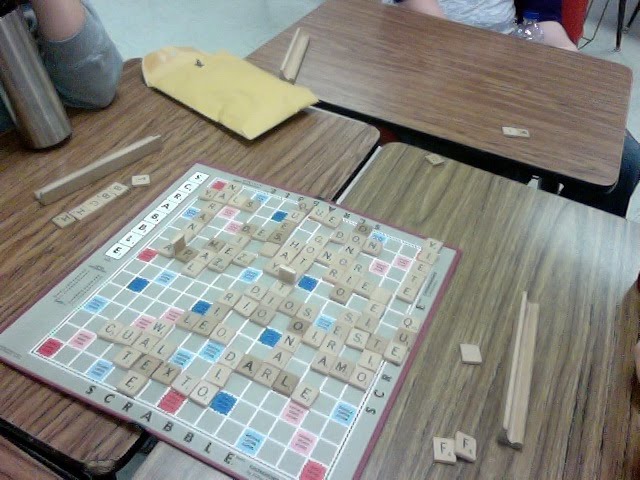
Teaching a World Language is often about building confidence in the language and showing students they CAN speak it. One day last week we had an "off" day. It was to mix things up a bit and to put away the computers. I pulled out some old Scrabble games and the kids created words from their vocabulary base. There was a host of unexpected conversations that took place.
1. What is that word?
2. Is this a word?
3. If I know ____, can I form ____?
4. What words start with/contain W?
5. How many vowels can I use in this word?
6. What was the ___ form of that verb?
7. others...
It was interesting to see some of the words they came up with during the game. There were also unexpected 21st Century Skills they were using in the process.
1. Creative problem solving - they didn't know what word to create or when there wasn't enough room to create the word. You can see one group just started building off the board. Another group put tiles upright to divide words that ran into each other. They also used what they already knew about the language to *ahem* create new words. Some were accurate; some were not, but they were manipulating the language nonetheless. SCORE!
2. Working as a team - if they didn't know what word to use, they would help each other out, not for personal gain, but for the gain of the group.
3. Leadership - They all took on a leadership role in the group at some point during the game. The stronger students helped the weaker students. Encouraging comments were given when a difficult word was accomplished.
4. Collaboration - some groups worked and counseled between groups to create words.
5. Self-directed learners - The teacher didn't have to be right there for them to create new words; they helped each other!
I think we'll do that again someday soon. :) Besides, we all had fun; that's what learning is all about!
Sunday, January 9, 2011
Making Metacognitive Students
Proficient learners are metacognitive, or aware of their own thinking. Teachers model their own learning processes when introducing learning strategies. Students talk and write about learning through process conferences and discussions. When teachers and students share their cognitive secrets, they are more likely to internalize processes. They become more aware of how learning and comprehending takes place. Metacognition is the key to deep understanding of content and the learning process. Lower elementary students to special needs students to gifted students can all be metacognitive beings and unlock the mysteries of learning.
This year I have tried to make my students more metacognitive in their learning by journaling through blogs. Second semester we will return to one-on-one conferencing because it is a powerful strategy that has been put on the back burner this year for my class. I have seen a dip in the learning curve and miss the personal, one-to-one relationship gained with my students during these conferences. Below are some examples of the questions I asked my students to reflect on at the end of each quarter. I encouraged their honesty and openness in their answers. They began to think about their own thinking and learning. Their open and honest answers revealed insights for me as a teacher to help them in selecting learning activities to match their learning style for future lessons. This reinforced what I have always said - students are very "with-it" when it comes to knowing what they need to learn; we just need to ASK them.
Quarter one metacognitive reflective questions:
a. The activities worked best/least to help me learn my vocabulary were.... because...
b. I prefer to work in a group/independently because...
c. I know I am learning when... because... I know I am not learning when I...
d. Based on my learning style, I will change... or I will do ... the same to maximize my learning process.
e. Other information I would like to share with Señora.
Quarter two metacognitive reflective questions:
a. What I did differently or the same this quarter versus last quarter to improve my learning was...
b. As I worked through the activities in class and at home, I realized .... about myself and how I learn.
c. Reading, writing, listening, and speaking are the 4 main skill sets we have been focusing on in learning a world language. My strength is ... My biggest challenge is ... Next semester I will try to ... to improve this skill.
d. Other information I would like to share with Señora.
This year I have tried to make my students more metacognitive in their learning by journaling through blogs. Second semester we will return to one-on-one conferencing because it is a powerful strategy that has been put on the back burner this year for my class. I have seen a dip in the learning curve and miss the personal, one-to-one relationship gained with my students during these conferences. Below are some examples of the questions I asked my students to reflect on at the end of each quarter. I encouraged their honesty and openness in their answers. They began to think about their own thinking and learning. Their open and honest answers revealed insights for me as a teacher to help them in selecting learning activities to match their learning style for future lessons. This reinforced what I have always said - students are very "with-it" when it comes to knowing what they need to learn; we just need to ASK them.
Quarter one metacognitive reflective questions:
a. The activities worked best/least to help me learn my vocabulary were.... because...
b. I prefer to work in a group/independently because...
c. I know I am learning when... because... I know I am not learning when I...
d. Based on my learning style, I will change... or I will do ... the same to maximize my learning process.
e. Other information I would like to share with Señora.
Quarter two metacognitive reflective questions:
a. What I did differently or the same this quarter versus last quarter to improve my learning was...
b. As I worked through the activities in class and at home, I realized .... about myself and how I learn.
c. Reading, writing, listening, and speaking are the 4 main skill sets we have been focusing on in learning a world language. My strength is ... My biggest challenge is ... Next semester I will try to ... to improve this skill.
d. Other information I would like to share with Señora.
Thursday, December 9, 2010
Conversación y Café


Today was a great day for South Hamilton Spanish students. Paulino Brener graciously gave an hour of his time to Skype with a packed classroom of students from Spanish II, III, and IV today. My administration willingly allowed them leave their classes and spend some extra time in my classroom to get a real-life, authentic learning experience. Some chose to actively ask and answer questions, while other observed and took notes.
The students prepared questions ahead of time via a Googledoc shared with Paulino. He helped them correct their mistakes in their writing and even chatted with a few who were online at the same time he was. During the Skype session, students asked questions, answered questions, interacted with Paulino via stories, music, and other cultural minilessons.
Adult guests stopped by or stayed for the whole session. Additional discussion followed afterward about how to use additional technology in the classroom.
We can't wait to do this again sometime. There is so much to glean from authentic experiences and we are grateful to have someone so giving to education! Thanks @sr_brener This was all possibly through Twitter!! Check out Paulino's post for this experience: http://bit.ly/fvRUfM
Paulino is also trying to get a $25,000 Pepsi Refresh grant. Please help him out with his project: http://www.refresheverything.com/latinoartminnesota Vote daily through December!
Thursday, December 2, 2010
PT Conferences- Necessary or Outdate?
At a recent staff meeting the faculty was directed to offer suggestions for improving parent-teacher conferences in our 7-12 building. I offer this question: Why do we have conferences in the first place? What is the purpose? How effective are conferences now? How are we evaluating this effectiveness?
In recent conversations with various administrators, department heads, faculty, and other educational leaders, my observations are that the success of parent-teacher conferences is based on the attendance of parents, how these conversations improve and change academic behaviors, and the connections made between home and school. The purpose is to inform parents how their child is performing in the classroom and his/her progress in the learning process. The state merely mandates that there be X number of hours set aside for communication between parents and the school in regards to the learning process; it does not mandate how that will be done. Thus, the school is not legally bound to parent-teacher conferences per se.
If our goal is to get more parents into the building on a regular basis, we need to consider why they are not entering the building. I passionately believe the school needs to provide a positive, non-threatening, inviting environment that makes the parents want to be here. All parents want to see their child succeed. Yes, even the kid who is failing multiple classes.
Given this, I propose the following for your consideration:
1. Back to School Night
My observation is that the first set of conferences is the most attended, especially by new families and the new 7th grade students in the building. This leads me to believe, through observation and conversations with parents, that one of their main purposes is to meet the teachers to make a personal connection. They want to know what kind of person is working so closely with their child. First impressions obviously mean a lot! If we have a Back-to-School Night at the beginning of the year to invite parents into the building, walk through their child's schedule, meet their teachers, hear what the expectations are for each class, get a feel for what the year will be like in that classroom, and to ask questions and chat with school personnel. This is a way to fulfill the need for the families of the "new kids on the block". Everyone gets started off on the right foot. Relationships are formed immediately. There is a face to attach to the email or phone call that comes later. The obligation to come would be to get their schedule for the coming year.
2. Orientation Days
There is a verbalized need to help transition life from the elementary building and the walk across the parking lot to the MS/HS building. We all know there are physical, emotional, social, mental, and psychological changes that happen during middle school. First time parents are new to this. How can we help them embrace these changes and not fear what is about to happen to their "baby"? How do we empower the parents to make difficult decisions in matters of discipline, homework, and social norms?
The 7th grade orientation may look like a pep talk or a child development lesson or a lecture on the rules of the building that are different than what they are accustomed to and what is expected of their child on a daily basis now that they are in the "big building". This may also include a walk through the school to help them understand the layout, where their child is going and how he/she is moving during the school day, or where to contact someone if they need help with XYZ.
There is also a need to transition from a middle school setting to high school life. What changes take place? Why are my grades so important now? How will the choices I make now affect my opportunities later? What path do I want to follow after high school? How do I keep my options open?
The 9th grade orientation may look like a college fair with the different departments set up in "booths" to explain what the minimum requirements are for graduation, what classes are suggested for entering a 2-yr college, 4-yr college, the military, job placement, and other post-secondary opportunities. Former students could be invited back to share their wisdom of life after high school from each of these different avenues. The counselor and administrators would be available to help with a 4-yr plan. It would be strongly suggested to have parents attending to listen to the same message as their child and to collaborate with the school personnel to create a long-range plan to meet the goals of each individual student. Not only may this decrease the number of adds/drops from classes at the beginning of each semester, but may also give a purpose for why they are taking each course. This 4-yr plan would also be reevaluated on an annual basis.
3. Student showcase
Sometime throughout the course of the school year, maybe a couple of times, parents and the public are invited in to an academic celebration. Yes, I mean celebration - make a big deal of the great things students are doing in their classes. They would showcase the projects they have created in their classes, the knowledge that they have gained as a result of taking each course by demonstrating what they know and can do. What makes math interesting? What is cool about the shop? How are the laptops used in PE? How are kids connecting to the outside world? How are they collaborating, working as a team, and gaining other necessary skills to compete in the 21st Century?
4. Alternative Communication
My district is a 1:1 school - each student is issued a laptop to use for school-related purposes. They have the tools at their fingertips to access resources and maintain close communication with their teachers, peers, and the outside world. @limbert65 has been known to say "You can't build a 21st Century school in a 19th Century community." We have the tools to connect with any parent, anytime, anywhere. Teachers are constantly in communication with parents via email, phone calls, notes home, blogs, online grading, ball games, the local convenience store, and countless other ways. There is no excuse for a student to go unnoticed in our district. If there is a problem, teachers are communicating. Period. For this purpose, parent-teacher conference is an antiquated tradition for addressing the communication issue.
5. Parent Volunteers
Ok, so this may not fulfill the parent-teacher conference alternative, but we do need to help parents feel welcome and invited into our environment. Our elementary has a host of parent volunteers, but that seems to stop when their child takes that transitional walk across the parking lot to the "other building". Parents and community can help out in a class or the office, make concert programs, make copies, run errands for teachers, tutor struggling students, help students with troubleshooting computers, present in classes about their job, their hobbies, their life experiences, and much more. Anything to get parents involved in the school, in the classes make them feel a part of the learning environment and sense of civic duty as well. Students get a break from hearing their teachers and build relationships with community members.
Finally, I am not necessarily proposing a complete end to any conferences. However, I think with the age of technology and all the ways we have to communicate the classroom to home that we are hanging on to an antiquated tradition that needs reform. I will gladly set up a face-to-face conference with any family that would request one. I don't think it should wait until a specific date on the calendar, twice a year. The key is constant communication! Stagnation is a step backward. We need to question what we are doing on a regular basis in order to move forward even if that affirms that what we are doing is effective. If we never question our actions, we never get to see what else is out there. What are other ways to bring parents into the building to make connections and build relationships between school and home?
In recent conversations with various administrators, department heads, faculty, and other educational leaders, my observations are that the success of parent-teacher conferences is based on the attendance of parents, how these conversations improve and change academic behaviors, and the connections made between home and school. The purpose is to inform parents how their child is performing in the classroom and his/her progress in the learning process. The state merely mandates that there be X number of hours set aside for communication between parents and the school in regards to the learning process; it does not mandate how that will be done. Thus, the school is not legally bound to parent-teacher conferences per se.
If our goal is to get more parents into the building on a regular basis, we need to consider why they are not entering the building. I passionately believe the school needs to provide a positive, non-threatening, inviting environment that makes the parents want to be here. All parents want to see their child succeed. Yes, even the kid who is failing multiple classes.
Given this, I propose the following for your consideration:
1. Back to School Night
My observation is that the first set of conferences is the most attended, especially by new families and the new 7th grade students in the building. This leads me to believe, through observation and conversations with parents, that one of their main purposes is to meet the teachers to make a personal connection. They want to know what kind of person is working so closely with their child. First impressions obviously mean a lot! If we have a Back-to-School Night at the beginning of the year to invite parents into the building, walk through their child's schedule, meet their teachers, hear what the expectations are for each class, get a feel for what the year will be like in that classroom, and to ask questions and chat with school personnel. This is a way to fulfill the need for the families of the "new kids on the block". Everyone gets started off on the right foot. Relationships are formed immediately. There is a face to attach to the email or phone call that comes later. The obligation to come would be to get their schedule for the coming year.
2. Orientation Days
There is a verbalized need to help transition life from the elementary building and the walk across the parking lot to the MS/HS building. We all know there are physical, emotional, social, mental, and psychological changes that happen during middle school. First time parents are new to this. How can we help them embrace these changes and not fear what is about to happen to their "baby"? How do we empower the parents to make difficult decisions in matters of discipline, homework, and social norms?
The 7th grade orientation may look like a pep talk or a child development lesson or a lecture on the rules of the building that are different than what they are accustomed to and what is expected of their child on a daily basis now that they are in the "big building". This may also include a walk through the school to help them understand the layout, where their child is going and how he/she is moving during the school day, or where to contact someone if they need help with XYZ.
There is also a need to transition from a middle school setting to high school life. What changes take place? Why are my grades so important now? How will the choices I make now affect my opportunities later? What path do I want to follow after high school? How do I keep my options open?
The 9th grade orientation may look like a college fair with the different departments set up in "booths" to explain what the minimum requirements are for graduation, what classes are suggested for entering a 2-yr college, 4-yr college, the military, job placement, and other post-secondary opportunities. Former students could be invited back to share their wisdom of life after high school from each of these different avenues. The counselor and administrators would be available to help with a 4-yr plan. It would be strongly suggested to have parents attending to listen to the same message as their child and to collaborate with the school personnel to create a long-range plan to meet the goals of each individual student. Not only may this decrease the number of adds/drops from classes at the beginning of each semester, but may also give a purpose for why they are taking each course. This 4-yr plan would also be reevaluated on an annual basis.
3. Student showcase
Sometime throughout the course of the school year, maybe a couple of times, parents and the public are invited in to an academic celebration. Yes, I mean celebration - make a big deal of the great things students are doing in their classes. They would showcase the projects they have created in their classes, the knowledge that they have gained as a result of taking each course by demonstrating what they know and can do. What makes math interesting? What is cool about the shop? How are the laptops used in PE? How are kids connecting to the outside world? How are they collaborating, working as a team, and gaining other necessary skills to compete in the 21st Century?
4. Alternative Communication
My district is a 1:1 school - each student is issued a laptop to use for school-related purposes. They have the tools at their fingertips to access resources and maintain close communication with their teachers, peers, and the outside world. @limbert65 has been known to say "You can't build a 21st Century school in a 19th Century community." We have the tools to connect with any parent, anytime, anywhere. Teachers are constantly in communication with parents via email, phone calls, notes home, blogs, online grading, ball games, the local convenience store, and countless other ways. There is no excuse for a student to go unnoticed in our district. If there is a problem, teachers are communicating. Period. For this purpose, parent-teacher conference is an antiquated tradition for addressing the communication issue.
5. Parent Volunteers
Ok, so this may not fulfill the parent-teacher conference alternative, but we do need to help parents feel welcome and invited into our environment. Our elementary has a host of parent volunteers, but that seems to stop when their child takes that transitional walk across the parking lot to the "other building". Parents and community can help out in a class or the office, make concert programs, make copies, run errands for teachers, tutor struggling students, help students with troubleshooting computers, present in classes about their job, their hobbies, their life experiences, and much more. Anything to get parents involved in the school, in the classes make them feel a part of the learning environment and sense of civic duty as well. Students get a break from hearing their teachers and build relationships with community members.
Finally, I am not necessarily proposing a complete end to any conferences. However, I think with the age of technology and all the ways we have to communicate the classroom to home that we are hanging on to an antiquated tradition that needs reform. I will gladly set up a face-to-face conference with any family that would request one. I don't think it should wait until a specific date on the calendar, twice a year. The key is constant communication! Stagnation is a step backward. We need to question what we are doing on a regular basis in order to move forward even if that affirms that what we are doing is effective. If we never question our actions, we never get to see what else is out there. What are other ways to bring parents into the building to make connections and build relationships between school and home?
Subscribe to:
Posts (Atom)