A reader asked me to post about teaching family. I like to use famous people and make a fictitious family because I do not know all the social relationships and I could easily offend someone making them part of the family or not. Also, being a TPRS/CI teacher, it has to be comprehensible and all in the target language. Those of you who are familiar with TPRS/CI, this is a variation of ask-a-story.
By the time I get to this part of the lesson, the students know a sufficient amount of descriptive vocabulary and some very basic family words. This makes the first part review and we slow it down when getting into more detailed family members. One of my goals for this lesson is to focus on the N de N method of possession: la hija de Michelle.
Start small and work towards more complex. As stated earlier, students already know these words so it is merely review and accessing their background knowledge. TPRS involves lots of questioning using comprehensible input. So, I will start off with...
[pointing to Barack] "Clase, ¿Es Barack un hombre o una mujer?" Sí, es un hombre. [We can then briefly describe Barack] "Clase, ¿Tiene Barack un esposo?" No, Barack no tiene esposo. Barack tiene una esposa. "¿Cómo se llama la esposa de Barack?" Sí, la esposa de Barack se llama Michelle. "¿Es Barack un esposo o una esposa de Michelle?" Sí, Barack es un esposo; es el esposo de Michelle. This line of questions will continue until I feel most of the class is comfortable with these words. Then we go to the next picture...
It's interesting that some students don't realize that Barack and Michelle are from the previous picture so I will make a few quick questions again about their relationship. Then I add in questions for "hijas":
"Clase, ¿Quién es la esposa de Barack, Malia o Michelle?" Sí, Michelle es la esposa de Barack. "¿Michelle y Barack tienen hijos o hijas?" Sí, tienen hijas. "¿Cómo se llaman las hijas de Michelle?" Sí, las hijas de Michelle se llaman Malia y Sasha. "¿Cómo se llaman las hijas de Barack?" Sí las hijas de Barack se llaman Malia y Sasha. "¿Es Malia un hijo o una hija de Barack?" Sí Malia es la hija de Barack. This questioning continues until I feel most of the class is comfortable with these words. I may ask them to turn to a partner and use the words "esposo, padre, hijo", or forms of the words, to describe the First Family.
This is the point where obviously it is no longer an accurate family tree for the Obamas. This is where TPRS becomes really fun! The above line of questions continues for this vocabulary. In this diagram, Beyonce is the sister to Barack and Bill is the brother to Michelle. Once they start to get comfortable with the vocabulary, you can add in any additional details or descriptions that you have been working on to start to create a storyline for the family. The crazier the better is what TPRS is all about. Be sure to return to earlier vocabulary to continue circling the information and get more aural repetitions. I like to pretend I'm getting confused and say things like Barack is married to Beyonce so that they have to correct me, or that Sasha is the sister of Bill.
A basic storyline has ensued and now we have additional family members. Whenever a new set of vocabulary is introduced, be sure to circle the relationships using the N de N possession as much as possible. In this diagram, Morgan and Diana are the parents of Barack and Beyonce. However, Michelle and Bill's parents have already passed. Yes, this makes for an interesting plot twist to the story. Reasons for their passing can become very comical, especially given that they are talking about the First Family. Sometimes I will include "in-laws" if I have a particularly advanced group of kids that need the challenge. Other times I feel accomplished to just get the basics done.
The final vocabulary has come. Gary is the son of Bill, the cousin of Malia and Sasha, and if you want, the nephew of Barack and Michelle. Gary, el primo, is the final family to be added so he is the one that resolves the problem presented in the story created.
Now that you have a quasi-complete family tree, you can easily review the vocabulary from today, including the N de N possession. Kids will remember the details of this diagram, including the vocabulary, because it is so bizarre and interesting to them.
For an assessment, simply giving them this family tree and having them explain it without the use of the vocabulary in view is a great way to have them show what they know. Asking them questions (orally or in writing) about the family tree is another way. Doing a quick write or a proficiency write looking just at the family tree will also provide you with a valid assessment.
Obviously any vocabulary you wanted to include could be substituted, along with other grammatical structures and people.
Seeking out new ways to educate students and expand the learning environment. Looking for out-of-the-box ideas for 21st century educational exploration.
Tuesday, January 26, 2016
Sunday, January 17, 2016
Café y conversación
When reflecting on our own personal language studies, what is the number one activity that helped us learn the most? Of course: speaking and living in the native environment. So, isn't it logical that we try to bring that to our students who can't or won't travel abroad? or at minimum simulate this environment?
Why?
I find random conversation one way to help hook students into learning. When we have authentic conversation about topics that students want to talk about, they ask better questions and learn at a higher level. This is why it is so important to put students in this situation. When they will need to use the skills we are teaching them, it will likely be speaking first. Culturally, Hispanics love to talk; they will sit around at lunch for a couple hours and just socialize, they will meet someone new and talk for an extended amount of time. This creates a perfect bonding time for the students to create their own culture and safe place in class.

When?
Living in the midwest, we see days that Mother Nature wreaks havoc on our roads so school is delayed or cancelled. These are obviously not planned so all of a sudden our schedule is interrupted and lesson plans need to be changed. This is when I call a "Día de Chocolate".
Preparation
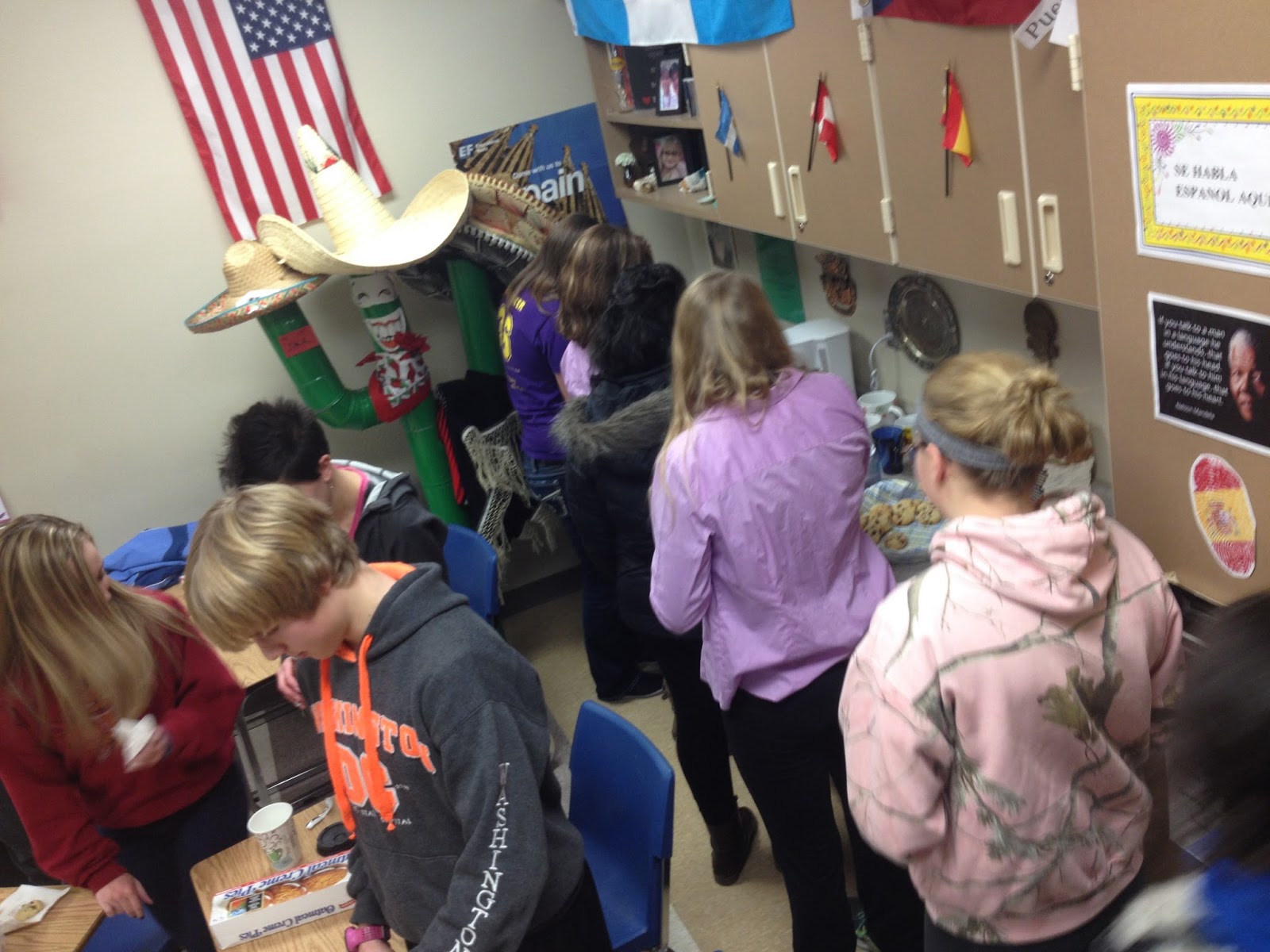
My room is always supplied with cocoa (complete with marshmallows), cappuccino, tea, and cider. There is also a coffee pot that has only ever seen water. I
replenish the supplies as needed and on our Días de Chocolate, I will bring in cookies, cinnamon rolls, bars, or some other treat as well. Often times students will bring in treats. Due to many schools having treat policies, the students usually bring in prepackaged treats, but I accept any treats anyone wants to make. This year I do have a couple students who are on a gluten-free diet so I prepare an alternative. The students choose to eat/drink; I never force or require anything.
Notification
I am also an avid weather watcher so I know days ahead if there is weather coming. I will warn students if it's obvious that there may be a late start. "Yeah, guys I hear tomorrow there is bad weather coming. Remember if we have a late start, it's a Hot Chocolate Day! This means you have to bring a mug and be willing to chat." When the call is made from the superintendent and/or we see it on TV, I send out a message to the students that it is officially a "Día de Chocolate".
Hot Cocoa Day
Most students do indeed bring their mug, but I do have a small selection of mugs for students to use as long as they wash it and return it before the end of class. Upon entering, I remind them that it's Hot Cocoa Day so they go to the counter, sanitize their hands, and prepare their beverage and snack. The desks are arranged in a circle to be more conducive to conversation. I will start the conversation off with small talk about what they did this morning with their extra two hours, how the drive in was, what they saw (cars in the ditch, etc), and other particular details of their morning. Once you get them talking, they will bring up other topics and the conversation continues throughout the class period. Some groups are more chatty than others, but I have never had a group that would just sit there and say nothing. The culture is created on day one that the expectation is 100% Spanish. They know that in order to improve their skills, they need to speak the language.

Reflection
Students really do improve and they really do start asking good questions.
In the end, this is a favorite activity of nearly all students.
Student comments
In an end-of-the-course evaluation, these were a handful of the comments I received from students about what they enjoyed the most about the class.
"Keep the same open environment. I was never embarrassed to say an announcement or talk out loud in class because I knew that she would help me if I needed it."
"She should keep having hot chocolate days and bringing in treats!"
"To apply food into the class it makes learning delicious."
"I liked that your teaching style was less serious but still made us get the work done that we needed to so that mind set was nice."
"When we got in a circle and just talked in Spanish for the whole day."
"I can't think of a favorite because I liked almost everything we did in this class. I enjoyed listening to the songs, reading the books, learning tons of new vocab and eating chocolate and having fun."
"The locked box game or having hot chocolate days and talking."
Why?
When?
Living in the midwest, we see days that Mother Nature wreaks havoc on our roads so school is delayed or cancelled. These are obviously not planned so all of a sudden our schedule is interrupted and lesson plans need to be changed. This is when I call a "Día de Chocolate".
My room is always supplied with cocoa (complete with marshmallows), cappuccino, tea, and cider. There is also a coffee pot that has only ever seen water. I
replenish the supplies as needed and on our Días de Chocolate, I will bring in cookies, cinnamon rolls, bars, or some other treat as well. Often times students will bring in treats. Due to many schools having treat policies, the students usually bring in prepackaged treats, but I accept any treats anyone wants to make. This year I do have a couple students who are on a gluten-free diet so I prepare an alternative. The students choose to eat/drink; I never force or require anything.
Notification
I am also an avid weather watcher so I know days ahead if there is weather coming. I will warn students if it's obvious that there may be a late start. "Yeah, guys I hear tomorrow there is bad weather coming. Remember if we have a late start, it's a Hot Chocolate Day! This means you have to bring a mug and be willing to chat." When the call is made from the superintendent and/or we see it on TV, I send out a message to the students that it is officially a "Día de Chocolate".
Hot Cocoa Day
Reflection
Students really do improve and they really do start asking good questions.
In the end, this is a favorite activity of nearly all students.
Student comments
In an end-of-the-course evaluation, these were a handful of the comments I received from students about what they enjoyed the most about the class.
"Keep the same open environment. I was never embarrassed to say an announcement or talk out loud in class because I knew that she would help me if I needed it."
"She should keep having hot chocolate days and bringing in treats!"
"To apply food into the class it makes learning delicious."
"I liked that your teaching style was less serious but still made us get the work done that we needed to so that mind set was nice."
"When we got in a circle and just talked in Spanish for the whole day."
"I can't think of a favorite because I liked almost everything we did in this class. I enjoyed listening to the songs, reading the books, learning tons of new vocab and eating chocolate and having fun."
"The locked box game or having hot chocolate days and talking."
Saturday, January 16, 2016
Slap Jack
Remember the good ole days of playing slap jack with your best friend? This led to a game to distinguish the present and past tenses, something they have been struggling with in class.
1) Students receive a pack of cards that have different forms of present and past-tense verbs. One student flips the top card.
2) If it reveals a past tense form, they slap it.
3) Before earning the card, the recipient would have to translate it using the correct form and tense of the word shown. If the partner agrees with the translation, he takes all cards.
For example, here are the cards revealed:
1) estaba slapped, translated, and won
2) es nothing done
3) van nothing done
4) fui slapped, translated, and won last 3 cards (es, va, fui)
The student with the most cards at the end, wins!
This activity could be expanded to a writing activity or even a speaking activity.
Writing: Students choose 5 of the verbs that they "won" and create an original story using them, similar to a quickwrite or a proficiency write.
Speaking: Using their cards, create a progressive story. One student begins by using their card to create the first sentence. The partner creates the second sentence. The story continues as they use their cards. Once out of cards, the student creates their own sentences to continue the story until both partners finish using their cards.
1) Students receive a pack of cards that have different forms of present and past-tense verbs. One student flips the top card.2) If it reveals a past tense form, they slap it.
3) Before earning the card, the recipient would have to translate it using the correct form and tense of the word shown. If the partner agrees with the translation, he takes all cards.
For example, here are the cards revealed:1) estaba slapped, translated, and won
2) es nothing done
3) van nothing done
4) fui slapped, translated, and won last 3 cards (es, va, fui)
The student with the most cards at the end, wins!
This activity could be expanded to a writing activity or even a speaking activity.
Writing: Students choose 5 of the verbs that they "won" and create an original story using them, similar to a quickwrite or a proficiency write.
Speaking: Using their cards, create a progressive story. One student begins by using their card to create the first sentence. The partner creates the second sentence. The story continues as they use their cards. Once out of cards, the student creates their own sentences to continue the story until both partners finish using their cards.
Sunday, January 10, 2016
Peer Editing
This past week, the end of a grading period and the end of the course, students have been preparing a movie version of a novel we have been reading in class. One thing that I wanted them to be able to do is become more aware of errors that they are making. One way to do this is to be able to recognize and correct errors in their writing.
Since this is a multiday project that they are working on, they need to be able to self-pace. I developed a form for them to complete each day. This helps them identify their successes for the day and also their plan for tomorrow.
Once the script was written, each student had to choose two peers to help them edit their script. This is not the traditional way that I have done peer edits, but I really like this. It makes them focus on the type of errors they are making, not the individual errors. They focus on tenses, vocabulary, and sentence structure.
What I really liked about this is what is shown in the photo to the left. Students really started analyzing the scripts. They started to ask great questions of the person who wrote it. They started to ask great questions of the person who analyzed their script. They started to really look at their writing and how to improve it.
I can't wait to see the final edits at the end of this week!
Since this is a multiday project that they are working on, they need to be able to self-pace. I developed a form for them to complete each day. This helps them identify their successes for the day and also their plan for tomorrow.Once the script was written, each student had to choose two peers to help them edit their script. This is not the traditional way that I have done peer edits, but I really like this. It makes them focus on the type of errors they are making, not the individual errors. They focus on tenses, vocabulary, and sentence structure.
What I really liked about this is what is shown in the photo to the left. Students really started analyzing the scripts. They started to ask great questions of the person who wrote it. They started to ask great questions of the person who analyzed their script. They started to really look at their writing and how to improve it.
I can't wait to see the final edits at the end of this week!
Wednesday, December 30, 2015
BreakoutEDU
Recently we had a PD day in which we were assigned to a room with our colleagues. My particular room assignment was facilitated by our principal. He told us a story of a professor who was trying to kill everyone off, but had a serum that would save himself. He kept it locked in a box (at the front of the room) and had left clues in the room about how to open the three locks. Our job was to find these clues, open the locks so that we could "breakout" of the room. We had 45 minutes and could use anything at our disposal, including electronic devices.
That was my first encounter with BreakoutEDU. The more I reflected on it, the more I thought I could recreate this in my language classroom. To make it even more interesting and challenging, I could have TWO boxes with different clues, thus two different teams in the same room trying to find and open different boxes, not knowing if the clue they found was really intended for their box or the other box. mooohahaha
We had just finished reading ¡Viva el toro! in Spanish III so this would be great. There was so much information about bullfighting as well as other cultural tidbits we explore at various degrees of intensity throughout the book. Knowing that the students had to use different skills to solve the problem than it usually took to have a discussion in class, this was about to get real interesting! Some of the locks were numbers; others were words. I really thought box 2 was more difficult.
Out of the 3 groups, only one group was able to breakout. It was interesting to watch the students work in this different capacity. Another group wanted to keep trying to figure out the clues, just to open the box. The challenge was greater than the prize for them.
I learned a lot about myself as well. As a teacher, I really want to see my students succeed and feel success along the journey. It was really hard to not give them free hints along the way. I had to wait for them to turn in one of their two hint cards. Sometimes they got fixated on an object that had nothing to do with the clue or be so close to solving it, but just couldn't get it, even when it starred them in the face. Taking a back seat is really really hard for me. I wanted to push them in the right direction and guide their journey, rather than let them discover and explore. It's too bad our schedule is dictated by minutes and hours. It's a necessary evil, however.
These were the two boxes, the combination, and the clues to find the correct combinations to unlock the box. It was a great day in class and we all learned.
Box 1
Lock: Clue:
TOROS “seven arrive, but only one leaves” <black light written on bullfight picture on bulletin board
496 bit.ly/secuestradora
41001 address to the bullfight arena
Box 2
Lock: Clue:
ARTE- “The clue is in the view, Julio.” <black light written on bullfight picture on bulletin board
490 bit.ly/secuestrador
56978 km > miles river basin
Copy of the letter that the "secuestradora" sent to Julio. Some letters are changed to purple, which spell out a bit.ly link to another clue.
Julio,
Tenemos tu novia, Ana.
Todo está bien, pero necesitamos dinero.
Nos reunimos en Sevilla a la Plaza de toros a las dos de la tarde.
El paseíllo revela dónde está tu querida.
Cuando nos reunimos, podrán tomarla y estar con ella nuevamente.
Sinceramente,
La secuestradora
The Pulsera Project
A few years ago I heard about the Pulsera Project, a free-trade organization that helps provide scholarships and jobs for people of Nicaragua. After a presentation on how to make your classroom a global classroom during an PD day, a teacher asked if I would partner in this project. Absolutely!
We solicited administrative support and approval and were able to move forward with the project. After watching a couple videos from www.pulseraproject.org the students were very excited to help the people of the Nicaraguan village. We had the students create a commercial for the pulsera sales during conferences, lunch, and before a school music concert. We showed the commercial repeatedly during lunch to get kids excited about them, and held early sales just to the students of the two classes so that they could show their pulseras to friends. Students signed up via a signupgenius to sell the pulseras. They sold over $1000 worth of pulseras.Finally, we had learning stations that combined all 3 sections of classes, over 50 students, to experience what life may be like for Nicaraguans. These stations included games, music, literature, food, and make your own pulsera. A final reflection piece ended the project and students commented on what they had learned. Wow, so exciting to see their minds and hearts opened to other people and cultures.
Honeycomb
Nope, not the cereal; it's the review game.
I got this game from somewhere I don't remember over 15 years ago. I thought it would be a good to pull it out again. This can be done as a whole class with 2-4 teams, but I chose to have the students work individually, competing against each other.
They were given a copy of the game board, an individual marker board, and a marker. Their grouping was according to their marker - each group had one of each color. When they won a question, they colored in the spot on the game board. The goal is to fill in areas top to bottom, strategically blocking opponents and circumnavigating their partner's blocks. If you have a particularly competitive group, this can get a little crazy.
I got this game from somewhere I don't remember over 15 years ago. I thought it would be a good to pull it out again. This can be done as a whole class with 2-4 teams, but I chose to have the students work individually, competing against each other.
They were given a copy of the game board, an individual marker board, and a marker. Their grouping was according to their marker - each group had one of each color. When they won a question, they colored in the spot on the game board. The goal is to fill in areas top to bottom, strategically blocking opponents and circumnavigating their partner's blocks. If you have a particularly competitive group, this can get a little crazy.Sunday, December 13, 2015
Tape Stories
This is another reading strategy that I have used a few times in the past. A few years ago I was out garage saling in the spring and found a big box of old register tape for less than a dollar. At the time I had a daughter who loved writing stories. I thought this would be a great outlet for her to write a long of a story as she wanted to. Then I realize, hey this would be a great idea for my students in class to write stories!We just got done reading Chapter 7 of ¡Viva el toro! They acted it out, answered lots of circling questions, among other activities. Today, with a partner, each group was identified as a writer or a drawer. As a group, they decided what to write in their summary. The writer wrote the words on the register tape and the drawer drew what was written.
In the past, I have used this in a variety of ways: they have to include x number of structures, sentences, feet of paper, etc. Sometimes it's a competition to see who can use the most paper. This usually results in students writing larger than normal with bigger spacing, however. With this activity this week we just showed off how long our chapter summaries were.Monday, December 7, 2015
Literature Circles
We have been working on reading strategies in Spanish III, using an embedded reading and an Anticipation Guide and citing evidence from the text to support the statements. For the final reading, the students did an activity called Lit Circles. This goes back to the days of cooperative learning, but also gives a purpose for their reading.
The students had been through the first 2 versions of the embedded reading text and we had done lots of circling of the information with it. They were divided into 4 groups according to what they felt were their strongest skills or learning styles: Director, Dibujante, Diccionario, Resumen (sorry I couldn't get another D word in there lol). All the directores were in one group; all the dibujantes were in another group, etc. As they read through the final version, they used the filter of their job to read. The directors were the strongest students who felt like they really had a grasp on the chapter. The dibujantes did a pictorial summary of what was happening in the chapter. They diccionarios understood every word of the chapter, looking up any vocabulary or structures they didn't know or were unsure of. The resumenes were similar to the Dibujantes, but did a written summary of the chapter.

After doing a "cold read" of the full chapter with their group members, one person from each was reassigned to a new group so that there was only director, one dibujante, one diccionario, and one resumen in each group. They then read through it again, collaborating with their new partners. Moohaha, I just snuck in another repetition! As a whole group, I added yet additional reps by doing a Q/A a la Carol Gaab style.
Monday, November 23, 2015
Anticipation Guide to Reading
Spanish III is about to dive into the next chapter of the book, ¡Viva el toro! There were mixed reviews with the embedded reading the last time we did it so I wanted to engage them a bit deeper. They were also struggling with the vocabulary as there were many interruptions to the schedule this week and kids were affected by these changes in routine.
This strategy has been around for a long time, but I pulled it out again this week. The Anticipation Guide is a strategy that is revisited multiple times during a reading. The first time using this, students identify their opinion on what they think will happen in the chapter by marking "Sí" or "No" in the antes column. There is no right or wrong answer. Discussion can take place as to why they think these events will happen.
After doing the first version of the embedded reading, students identify which comment can be verified in the text. Using the después column, students verify with textual evidence what is accurate or what is not. Keep in mind that to make this effective, only reveal a few facts when you choose to what to include in each version. This keeps the students wanting to read more; it keeps the versions novel and interesting. Having them identify textual evidence makes them really interact and read more analytically throughout each version. It also gives them purpose for what they are reading.
What other strategies do you use to engage students with a reading?
This strategy has been around for a long time, but I pulled it out again this week. The Anticipation Guide is a strategy that is revisited multiple times during a reading. The first time using this, students identify their opinion on what they think will happen in the chapter by marking "Sí" or "No" in the antes column. There is no right or wrong answer. Discussion can take place as to why they think these events will happen.
Frase del capítulo
|
antes
|
después
|
evidencia
|
El Sr. de Marco trabajaba a la plaza de toros.
|
Sí No
|
Sí No
| |
Carmen no habló más con Ana
|
Sí No
|
Sí No
| |
Pedro y Ana son novios
|
Sí No
|
Sí No
| |
Ana era acostumbrada a todo ahora
|
Sí No
|
Sí No
| |
Ana quería ver a Julio Barquero nuevamente
|
Sí No
|
Sí No
| |
Ana y Julio estudiaban juntos
|
Sí No
|
Sí No
| |
Ana era experta en la Guerra Civil Española
|
Sí No
|
Sí No
| |
Julio conoció a unos presidentes, como Washington, Clinton, y Lincoln
|
Sí No
|
Sí No
| |
Ana fue a una corrida con Julio.
|
Sí No
|
Sí No
| |
Ana y Julio se casarán
|
Sí No
|
Sí No
|
After doing the first version of the embedded reading, students identify which comment can be verified in the text. Using the después column, students verify with textual evidence what is accurate or what is not. Keep in mind that to make this effective, only reveal a few facts when you choose to what to include in each version. This keeps the students wanting to read more; it keeps the versions novel and interesting. Having them identify textual evidence makes them really interact and read more analytically throughout each version. It also gives them purpose for what they are reading.
What other strategies do you use to engage students with a reading?
Subscribe to:
Posts (Atom)