Saturday, September 26, 2015

Student Choice

When given the option, I'll choose _____________ .

An assessment with a new teacher can be quite stressful. It doesn't matter the rubric, the preparation, nor the skill level, if one has an option of activities to show what one can do, given the same objective for each,  students will be more relaxed and confident in their abilities. This idea was reinforced to me this year as I enter a position in a different district. I love saying "yes" to students so I try to find ways to make situations for them to ask yes questions.

Recently we finished reading the second chapter of ¡Viva el Toro!  This was based on vocabulary that the students were working on via this story. After learning the required vocabulary, students then read the chapter. Of course this is a very simplified description of what actually happens, but the purpose of this blog post is on the assessment, not the reading itself.


After repeated circling of the information, the students are very familiar with each of the stories. They use the same vocabulary in different situations. At the time of the output assessments, each successfully presents either the class story or the chapter.

One way students presented a question to me that evoked a "yes" response, is to request the use of pictures notes. These are visual reminders of what happened in the story or the chapter so that they remember all the information they are to use. Some of my best ideas have come from students. I truly believe they know how they learn best and what they need to succeed. I also like to have a reflective question on tests that isn't figured into their grades. This offers additional insight into how they learn best and activities that I can use or ditch to better help them.

Can you tell which story this student chose to retell?


Thursday, September 17, 2015

Pattern puzzle presentations

I was looking for a strategy to use to get the kids into some higher order thinking skills. Spanish I has been reading the first chapter of Berto y sus buenas ideas. This is their first reading experience and they have been feeling much confidence and success with it. YEAH! First we read a paragraph or two and then they created picture notes for each new character introduced. Below is what we did after the picture notes to transform the information into something new, ie novel and compelling.

The first chapter of the book introduces Berto and his teachers, friends, and family, along with many descriptions of each person. I chose some of the characteristics and some of the people and put them on strips of paper.

With students in groups of 2, they organized the strips of paper. This is where it got interesting! Their learning styles really came out. Some of them immediately starting organizing their papers before directions were given. Some just scattered them so that they could see all of them at once. Some grouped them into different categories.

They were instructed to use either the people and identify characteristics or to use the characteristics and identify which people fit that characteristic. Either way, they had to understand what the paper was saying, evaluate which characteristics fit which person, and organize their information accordingly.


You can see in the pictures that some students have their text out (book) and some have their picture notes to help them remember or refer to when determining how to group the information. Some noted that some information was missing so I encouraged them to write in anything they wanted to in order to make their papers complete. I love that they came up with the idea that there was missing information.

When they finished grouping their papers, they were given tape to secure the papers where they wanted them on a fresh piece of paper. With their papers secured, the next step was to choose one character and prepare a short presentation in the target language using at least 5 descriptions. This meant that some had to add additional information. They then presented to the class. To hold the listeners accountable, they had to determine if what was being presented was accurate or not. Fortunately we didn't hear any errors so there was lots of learning happening!

Once the presentation was complete, they hung them on the wall to be displayed and refer to in the future.


Sunday, September 13, 2015

The Eraser Game

This is a game that I have played for years with my students. It originates from a game played in some Latin American country that I can't remember where nor the name. The students love playing this game and it can be a very fast-paced game, forcing students to pay attention and think fast.


As you can see in the picture, students have a vocabulary word or structure that is in English and attached to their desk in the front. It is written large enough for everyone to see. Another student is in the center with an eraser. One student starts by saying another student's word in the target language. That student must say someone else's word before the student with the eraser hits his/her hand.

Students sitting at their desks must have a hand in each corner of their desk. If they move their hands or desk, they are automatically in the center. The person with the eraser can not aggressively hit a student's hand, throw it, or hit any other body part: only the hand.

To mix things up a bit and to keep them on their toes, I have the students stand and move 1-3 seats to the left. They now have a new word to focus on. This prevents them from just remembering one word for the day. It also gets some of the quieter students into more popularly-said words so that they are more of an active participator, too. Another mix up is to pull out words that are said a lot. If they keep calling out a few words, I will remove them from the desks and add different words. Again, this keeps them thinking more quickly. Sometimes students will say the words that have been removed so the eraser student hits his/her hand and s/he is now in the center.

Historically, students have said this is a great way to "cement" the vocabulary and pick up the words they have missed due to illness or other reason not being in class. While this does not fit the philosophy of TPRS acquisition, it is a fun way to review vocabulary, old and new, and it does stick with the kids, offering a much needed brain break.

Tuesday, September 1, 2015

Student Selected Voluntary Reading

Another new activity that I started this year is SSVR. I never thought this was powerful enough to incorporate and I didn't think the students would take it seriously. At #iFLT15 this summer Dr Krashen mentioned that one could improve his proficiency from novice high to the top of the scale in 3 years by reading daily. This could be condensed to a short time frame with longer periods of reading, however. This changed my perspective on having students reading regularly.

Initially I thought we could use our class novel to read daily. However I was quickly reminded that this should be a student-selected reading and it should be whatever level book she wants, even if it means the book is far below her reading level. It doesn't have to be a challenge; it just has to be fun! Reinforcement of old words helps solidify one's vocabulary base.

This week we started SSVR for the first few minutes of class. I knew the answer, but needed a little more guidance so I went to my Facebook group to see how to best start out with SSVR. They had some good suggestions for me. I decided to present the idea to the students and read for 5 minutes. After reading, they completed a brief graph to hold them minimally accountable.

Bryce Hedstrom was unknowingly and instrumentally guiding me to make this work. I adapted his bookmark to give my students. We talked about ways to determine meaning of words they don't know when reading their books. I explained my own struggling experience learning to read in another language and how I overcame those struggles. Yes, I nearly gave up a degree in Spanish because I was too afraid of reading! I am still going strong 23 years later. I am living proof that reading can happen.

Before they grabbed a book to read, I showed the students their options in the classroom library, divided into proficiency levels of novice, intermediate, and advanced. I acquired books by buying them in book stores, library sales, garage sales, donations from my students' families, donations from other sources, and also flea markets and book stores over seas. I explained to them that all the books in the classroom library are my personal books and magazines for them to use and read. Some are very very old, others are brand new. They are available to them as a gift from me because I believe in their learning. The only payment I ask from them is that they respect the reading material and love reading.


After day 1, they are having a good time reading. Many students noted that they found a book that was easy for them to read and that they enjoyed the experience. I was equally excited at the number of students who wanted to challenge themselves with an advanced book. I am fully aware that this is the honeymoon period and that we will have to have more "meat" in the reading time in the near future. So, readers, if you do SSVR with your students, what are some activities that you use to keep them wanting more each day?


Friday, August 28, 2015

The Proficiency Journey

Earlier this summer Musicuentos posted this blog; Carrie Toth posted a picture of her bulletin board on twitter; Amy Leonard posted some summative proficiency scales in collaboration with Greg Duncan.

I combined all these into a mini lesson/bulletin board of my own that runs through the middle of series of cultural pictures, that is titled "The Proficiency Journey". There is a man with a briefcase that starts the journey (novice low) by sitting, then as he proceeds through the different levels one can see him standing, walking, running, and confident hands in the air.


We spent some time talking about the different proficiency levels, using anecdotal descriptions for tacos to better understand each one. Once the students understood the levels and about where students of each level might be placed, they were given a push pin. After identifying where they thought their skill was, they placed their pin in the location along the path.

It is my goal to have them reevaluate their skills two to three times per quarter. It may be that their pin continues forward along the journey, but it may be that they readjust their pin to a lower level. We will always be tweaking where we are most comfortable. Ultimately, I'd love to have them take the APPL test to truly evaluate their proficiency level. 


Sunday, August 9, 2015

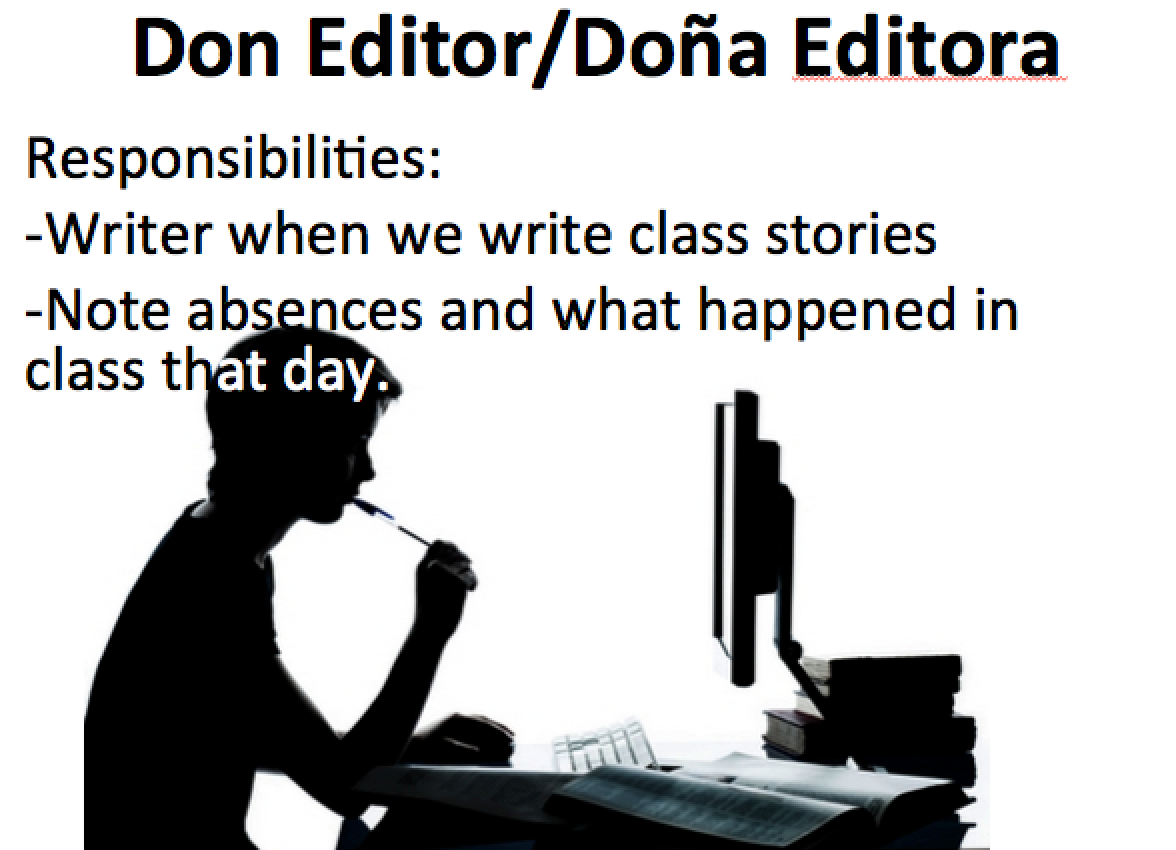
Classroom jobs

After attending the #iflt15 conference in July, I thought it would be good for me to start blogging about my experiences in a new district. While I am a 15-year tinkerer of #tprs (that's to say I used traditional TPR with mild aspects of TPRS in an exploratory class), I really only consider myself a 2 year veteran of #tci.

One thing that really struck a chord with me was the use of jobs in the classroom. So, this year I am going to venture into this method of trying to get students to feel more a part of our classroom, a self-sustaining classroom. Giving students a job gives them a purpose for being in class because we truly are all in this together.

Bryce Hedstrom and Ben Slavik are masters at doing this in their classroom and their job lists are, well, quite overwhelmingly long. I decided to limit jobs to "Los 10 Súper Trabajos". Perhaps later I will add more, but I thought 10 would be a good number to get this started. Start small and grow, right?

Los 10 Súper Trabajos


What else do these teach?
As teachers we are always teaching so even when doing seeming minimal work as assigning jobs to students, there is still a learning opportunity.
1. Don/doña as titles of respect and also "gift". We are all given special gifts in life and we need to tap into them and use them for the greater good.
2. Jobs - students need to explore careers they may be interested in. It also gives me an insight into their interests, personalities, and possible career choices.
3. Agreement - students see how the gender changes with words given if a male or a female is doing that job.

What's up with the Café Points and the bubblegum machine?
This is a motivational strategy that I picked from a former student, now colleague. I have used it past few years and the kids LOVE it! Again, this is something simple, but always a learning technique that comes in the "back door". This is explained in this previous post.

What are my concerns? 
1. The students will poo-poo the jobs and not embrace them like I envision.
2. I will forget to do this. I'm hoping to practice them in class so that it's a good reminder for me what these jobs are and the kids will hold me accountable for using them.
3. I have a class of 11 students. One student may not have a job. I will figure out in the next couple of weeks how to deal with one "unemployed" student.

Do you use jobs in the classroom? What jobs do you use in your classroom?

Tuesday, May 12, 2015

Los piratas: A visual review

We have been reading Los Piratas del Caribe the past few weeks in Spanish I. This was a great way to culminate their structures this year. We went fairly quickly as they already knew most of the vocabulary and structures presented in the book.


Day 1
Before the students read the final chapter, I wanted them to focus on the content, and also summarizing a text. Rather than the usual pictures (which they love to do!), I did a variation on this strategy. The students were given a piece of paper to fold "hot dog" style. One column was for a written summary; the other was for a pictorial summary.

We did a partner-read activity in which one student reads in Spanish and the partner reads in English. The second student then reads the next sentence in Spanish and the original partner reads in English. These role are volleyed back and forth through the end of the reading. I stopped the students at a predetermined spot in the reading. They summarized in writing what happened in that part and then drew a picture(s) to show what was happening. A picture is worth a thousand words, right?

After the third partner read, they were encouraged to reread the entire summary to be sure it flowed and made sense with what they already knew about the story and what was currently happening in the story.

As they started their project, many had their notes out referring to them occasionally to help remind them what the chapter was about.

 Day 2
The students answered the summarizing questions to the chapter based on their notes. After, they were each given 3-4 Wikisticks (Bendaroos). They looked for a group of 2-3 and were directed to recreate scenes from the chapter. Some of the characters included Henry Morgan, Antonio Medina, Raquel/Santiago. They also enjoyed getting creative with some of the images. This was a great creative outlet from many of my students. Some typically shy students opened up and really got into this part of the lesson.

They had to create 5 photos of their images by the end of the 40-minute class period. For nearly all students, this meant creating a character or two, snapping a photo, and then disassembling it to create new characters. By the time we got through the initial procedures of class and the questions, there was really only about 30 minutes to complete the photos. This meant about 6 min/photo.

After some time, students got even more creative with their images. Some students were looking for images of beach scenes for their characters to hang out or walk around. Having said this, there was no stop-motion creation going at, but they were starting to step outside the proverbial box a bit and create something unique.

Some mild troubleshooting was also taking place. For example, a group of two only had one functioning computer so they asked if they could leave the characters stuck to their computer screen and use their phone to take a picture of the characters in front of a backdrop. Why, certainly!

Eventually, the backdrops and phones weren't enough, they grabbed an individual marker board and started drawing extras on their characters, such as hair! Others identified names.


Day 3
Although we are not yet there, the students will be using their photos they shared with their group members via Google Apps to create a script and eventually a movie to retell in their own words, what happened in the final chapter of piratas. I'll post when I get them in a couple days.


Saturday, February 21, 2015

Motivation in the classroom: It's the small stuff


In looking at my classroom, I notice there are many things that I have set in place and things I do that are intended, consciously or unconsciously, to motivate students. One morning this week I started taking pictures of all these things. Below are twenty things you will find in my classroom. Enjoy!


 Rules - I have one rule in  my classroom: RESPECT! Everything else falls under this one rule. We take time at the beginning to talk about what respect means - respect self, others, space, learning styles (and learning rates), personal backgrounds. I have the word "RESPECT" posted in a few locations around the room to remind them. When I deal with disciplinary actions I always go back to this rule. My conversation starts with, "What is the one rule in this classroom? Were you being respectful? How are you going to fix this lack of respect that you have demonstrated to ______?"


Photos  - Senior photos are posted as they are given to me. After a few years I have to take some down because the top of my chalkboard fills up. The kids love looking at who the top kids were, at least who respected me enough as an educator and adult in their lives to give me a snapshot in time. I even have a few photos from underclassmen that I also post. :)

 Chicle - A few years ago I started bubblegum machines in my classroom. Each period has their own bubblegum machine that I add gum balls (chicle) to when something great happens, called Cafe Points inspired by Sr. Noble, or when a student aces an assessment. Once the machine is full, I bring an authentic dish that we prepare in class or one that the students can participate in creating. This is not a competition between classes, but rather each class pushes each other to fill the machine as many times as possible.


Media - I. love. books. I'm a book junkie. There are shelves of books in my classroom that are authentic resources for students. Some are free-reading type of books, some are resource books, others are magazines and pamphlets categorized in library-style magazine boxes. Students' interests are represented in these resources: cooking, automobiles, fashion, travel, etc.

Student of the Month - Each month I recognize a student who has been a leader in class, shown consistent effort in using the language, strives to do his/her best, and takes risks in and out of class. Notice that I do not include an overall grade percentage, letter grade, or anything related to grade. I am looking at behaviors - what are students doing to improve himself or herself. I am conscious, however, of the ratio of males/females that are recognized, but it does not play a large factor in deciding who receives the award. Students have used this award to apply for National Honor Society, scholarship applications, part-time employment, and other honors. The student will receive a certificate to archive the recognition and a pin that can be used to display on his or her letter jacket.


Passes - My district has moved away from formal pink passes to teachers just grabbing a random piece of paper, writing the necessary basic information "Molly to band 4th period 11:18 from Spanish". I decided to use inspirational quotes about language learning or travel to use as my passes. This not only gives the student something to look at as they are slowly making their way to class, but also serves as a publicity for my department. I am indirectly advertising and educating other people.


 Student work - This is the selfie generation - pictures mean everything. They like to see themselves and their work. There are always examples of student work on display, either in the classroom or in the hallways. I've noticed that hallway displays attract the attention of not only my students but all students who walk by them. Given this, one can assume that even though there are examples of Spanish IV work on display in the classroom, that even the Spanish I students and middle school exploratory students are looking them, trying to decipher what the message is.

As I'm writing, it occurs to me that even when students interrupt my class to have a prior signed or discuss a quick issue, this is also another way to "display" their work since I will only use Spanish to talk to them. Typically it is an upper-level student who comes in wanting or needing something in a lower-level course. It is fun for me to see the jaws drop that someone they know in their "English world" is all of a sudden communicating in another language. It has to be fun for the student I'm speaking with to see the underclassmen admire them for their skills in the language. What a confidence booster!


Standards for Foreign Language Learning - Above one of my chalkboards I have displayed the ACTFL standards. This is a constant reminder of the proficiency we are working towards: communication, cultures, comparisons, connections, and communities. If a student or parent asks why we are learning what we are, or why we are doing certain activities, I can immediately point them to these standards. It gives purpose to what we are doing.


Realia - This stove-pipe cactus was something I had inherited when I came to this position nearly two decades ago. I found it to be a bit boring so I had to dress it up a bit with a print out face, donated sombreros and blankets. Over the years kids have given the cactus names, using a name tag or decorated him with lights at Christmas time. He has even become a star in some of our stories that we tell. Sometimes in a particularly difficult class, we can lighten the mood in the room by blaming the cactus for loud students, paper on the floor that no one wants to pick up, or other shenanigans.


Flags - speaking of realia, flags from various countries are hung. The first year I had these, the students were very intrigued by which country was represented. It took some a little while to figure out they were all Spanish-speaking countries. Ironically, I do not have one from the US. This, of course, is the fastest growing Spanish-speaking country in the world!  These flags have also been used to take trips. For example when we learn the structure "va a" we can talk about going to Colombia, Puerto Rico, España, Perú, Guatemala, Cuba, México, or Argentina. Our student actors actually go to the flag to show that they are in that country.
Cultural Bulletin Boards - One thing that I lack in my classroom is bulletin boards. So, instead I have large walls to fill. I use them to display images of things we are working on in class. For example, the picture collection at the left is a series of war posters from the Spanish Civil War that Spanish III used to talk about at the beginning of the year. The images and words were discussed and analyzed to better understand the mindset of the time, comparison between the Spanish Civil War and the Iraq War, and to set the stage for the students who will be traveling to Spain with me this summer to see the Valley of the Fallen.

Street signs - not all street signs look like the narrow green signs stuck at the top of a post on a street corner. These are the street signs in Madrid, Spain. While there, I took pictures of some of them and now have them displayed in my classroom in the corners, as if it was an intersection of two streets. As students inquire about what the artwork is, we have a mini lesson on street signs.

TV - Remember the days of Channel One being pumped into your classroom for 12 minutes during homeroom/seminar? Our equipment was removed, but the TV stand was still there. It was quite an eye sore so I decided to repurpose it with our own Spanish Channel :)  I often take pictures of my students so periodically I "change the channel", putting up a new pictures of students from class or from social events like dances, games, or fundraisers. Again, the kids love to see themselves published so this is another way to show them off.


Classroom layout - Let's face it, we teach language and languages were meant to spoken. Something that I have felt strongly about since graduating from college is that the classroom should a group event: we are all working toward the same goal - communication. Students should help each other because, hey the teacher doesn't know it all! It also produces an environment in which students become teachers and leaders in the classroom. The more you teach another person, the deeper you understand the content. Having the desks arranged in a U-shape encourages this communication. I also have never wanted a back-row seat. While this is next to impossible in today's classroom, only have 2 rows helps to prevent a student from becoming unnoticed; you can't hind behind someone if there is only one person in front of you.


Pencils - this may sound like a petty thing, but I really don't care what students are writing with, use crayon if you want, just write! It really irritates me when I hear a student was removed from the learning environment because he or she didn't have a pencil that day (not a pen, but a pencil! Seriously? The principal has bigger fish to fry than that). I have a small box at the front of my desk that has a supply of writing utensils and erasers. A student may have to sharpen it, but there is always at least one writing utensil in there. I never have to hear the complaint, "I don't have a pencil!" They just know they can go to the box.


Mini lessons in a box - ok so these are really post-it notes. I have a big variety of colors, shapes, and sizes. When a student comes to me with a question, I can grab a paper, make some visual comments for them, and then stick it to their computer, notebook, or whatever they have brought to me. It serves as a constant reminder of what we have talked about until they choose to dispose of it. I also use these to leave notes for students or them to leave notes for me. Sometimes students prefer to talk to me via a message so they know they can use these at any time.

Photo collages - Similar to the cultural bulletin boards listed above, I take all kinds of photos abroad (3000ish images per trip). This makes it relative easy to create inquiry-based stations around the room. The one to the left is about native people abroad: clothing, street performers, transportation, shopping. The one at the bottom is about dining, food, tipping, and language usage...my students were given free tapas at a restaurant in Segovia because the waiter was impressed with their language skills! He was accustomed to students on "fly-through" trips who couldn't really speak the language, just wanted a quick tour of a foreign country. I always tell my students, "You never know what a language will get you; in this case a free meal!"


Memes - When I find a cute language meme, many in Spanish, I print it off and add it to my wall. Students are allowed to "wander" during class to take care of their needs, such as sharpening a pencil, blowing their nose, etc. This wall is located near the entrance to my classroom, which is also by the pencil sharpener and main garbage can. While most students don't abuse this, I know a few will pretend to have a cold or a weak pencil just to check these out. lol 


 Music - I have a small library of music. This was purchased a few of years ago. Now that CDs are on their way out and online resources are plentiful, my library has become more digital. Students love music and have a strong connection with music. It not only creates mood, but also gives the students a model for pronunciation and new vocabulary. It's a different way to look at reading and listening.
Life-long learning - I have mentioned my love for books and resources. It is so important to model for students what you want them to do and how to act. If we want them to develop a love for learning, we have to model this. I have a personal library of professional books and resources that I use. My students know that I am passionate about not only teaching and learning, but also the Spanish language and culture. They may catch me reading blogs, listening to TedTalks, music, or webinars, reading twitter posts from my Spanish colleagues and friends abroad, or sending emails in Spanish.


 What are some ways you motivate students to want to come back tomorrow? I'd love to hear them.