Sunday, March 9, 2014

Pobre Ana HISHE

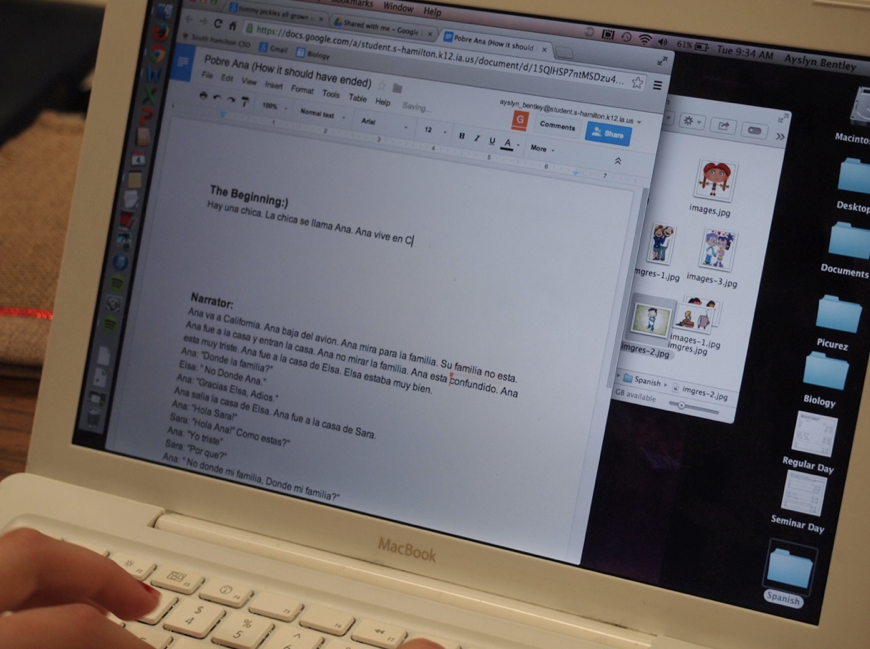
We are all enamored by the How It Should Have Ended videos on youtube. This idea sparked the cumulative project for the novel by Blaine Ray, Pobre Ana. Students have read the novel this quarter while learning grammatical structures, vocabulary, and cultural topics. Their final project was to create an alternative ending, while maintaining the integrity of the novel's storyline and using the structures from the story.

The students could work solo or with a partner, using voicethread, makebeliefscomix, iMovie, blabberize, bitstrips, storyboardthat, etc. They were only limited by their creativity beyond these requirements. Students started exploring various suggested websites, setting up accounts, and writing their script.


Students then produced their movies and they are published here:
Please vote for your favorite or add comments at the bottom of this post. We'd love to hear from you.


Friday, October 11, 2013

2013 IWLA Conference

These are my presentations for the IWLA Conference:

Session 1: 8:00 Friday presentation
2013 Central States Council on the Teaching of Foreign Languages Report
Council Bluffs Room

Session 2: 10:45 Friday presentation
Learning Through Web 2.0: A Virtual Presentation
Cedar Rapids Room

Session 8: 10:20 Saturday presentation
1:1 in the Language Classroom (iPad vs laptop)
Cedar Rapids Room

Sunday, September 22, 2013

A Child's Reflection

Scott McLeod's recent post got me thinking.  Last week my child came home from school and we were talking about one of her classes, how it was going, and what she was doing.  This was not a class that she wanted to take, but one that her mother emphasized would be good for her and a good challenge.  She commented, without agreeing it was enjoyable of course, that it was a course that she might come to like.  I asked her why.  "Because in my other classes it's just memorization, but in this class, there are no correct answers.  I can be creative.  It doesn't have to be one and only one answer."

I think this is really a depressing state of affairs that students see education as this low-level, input-regurgitate style approach.  Some of this is necessary to get basic facts, but to base the entire educational curriculum not only doesn't advance our future leaders, but also doesn't push our kids' thinking and challenge their thoughts.

How are we helping students to see what life and the rest of the world has to offer if we are set in a "sit and git" style of teaching and learning?  How are students collaborating with those outside their district, state, and country to compare how others are learning, how they are similar and different from themselves, and how their culture is really not as foreign as we may think?  Why is it that in the 21st century we still have teaching focused on the teacher and not the student?  How are teachers being encouraged (and restricted from) using the vast amounts of technology available to them?  Are there support systems in place to make all this happen?

What am I doing to combat these challenges?  In my own classroom students Skype with and collaborate with other classrooms around the world - Spain, Argentina, France, US.  Students create their own stories, both digital and face-to-face in class, offering the direction of where the lesson will go, the vocabulary to be learned, and the conversation to be entered.  Check out these stories!

My daughter did not set out in the conversation to accuse anyone of anything, nor am I.  However, it was a very bold statement of what life is like for high school students around the country.  Thank you Mr. McLeod for your timely post regarding the 3 Big Shifts.  I think we still have a ways to go.

Wednesday, May 8, 2013

Using Technology to Reach 21st Century Goals

It's the end of the school year so I have been doing lots of dreaming for next year while reflecting lately on the events of the past year.  What do I love the most?  Real-life assessments!  I brag about my students regularly and cheerlead them almost daily.  What does a teacher know, right?  Within a week's time we have three, yes, THREE major assessments going on in class.

EVENT #1

Monday Spanish II students skyped a classroom in Argentina to practice the past tense.  This is our sister classroom in Buenos Aires.  South Hamilton students took turns talking to students in the ORT classroom who were learning English.  The Argentinian teacher and students commented on the kids' great Spanish.  This is a real-life test and the students succeeded with flying colors! 


EVENT #2:
The evening before, I got a call from a friend who wanted to do a project.  She wasn't sure what it would look like, but she had a goal and it matched what I was wanting to accomplish at the end of the year too so we moved forward, quickly!  Created within 24 hours, it has now gone international and gained world-wide attention! Information can be found here.  This post includes pictures of our students here at SH.  The details can be found here.  This is technology use at its maximum: google docs, google presentation, twitter, symbaloo, google hangout, and email are all included.  Over 21,000 people are watching this project unfold remotely around the world.  How cool is that?!


One of the responses to the final reflective assessment was:


Learning about Spanish art was very interesting. I noticed that a lot of the art was influenced by other parts of Europe. They also had a lot of Art schools there that produced a lot of famous artist. They have a lot of art museums that display these famous works. Artist, such as Picasso, influenced as well as displayed their culture, which showed that Spain was very art interested.
The other countries, such as Costa Rica and Peru had a very different style of art. While Spain was more European and renaissance,  Peru had a much more “tribal” version of art as well as portraits like Spain. The artists in Costa Rica and Peru also displayed a lot of the culture of their countries, as well as some of the government problems, like Spain as well. Although they are also interested in the arts, they weren’t so much influenced by Europe or the countries around them, giving them their own look at things.
It was interesting reading about the other countries as well as my own. I thought it was fascinating that although they speak the same language, their culture, homelife, and even dialect is very different indeed. It really showed that each of these countries are all of their own, and the stereotypes and grouping of spanish speakers being all form the same country  should not even be considered because they are not the same, and I think that this was a learning experience that was one of the intentions of this project. It also made me curious to learn more about these countries because they seem pretty cool.  


EVENT #3 Next week a former student who is currently serving in the Peace Corps in Ecuador will be visiting with all classes, presenting in Spanglish about her cultural experiences.  I will update this blog after she comes....


We are indeed living in exciting times, exponential times!