This is the video created to help parents understand the changes taking place from a traditional classroom to one utilizing standards-based grading, flipped class, mastery learning, and immersion.
Sunday, August 28, 2011

Wednesday, August 24, 2011
The Portal of Change


The first week of a new approach can be nerve-racking and exciting all at the same time. I couldn't be more pleased with how the first week has gone. The first 3 days were spent experiencing the rationale behind the changes.
Day 1: Mr Miyagi and language learning through immersion (Thank you to whoever posted that idea!)
Day 2: What is a family? Standards-based grading and mentoring
Day 3: What is my grade? Why don't I have a letter grade? Flipping with mastery
A little background on what's different, aside from the above listed items: When I take students abroad, they love the family stay and say they learn the most. We learn our native language in the comfort of our homes surrounded by language users of all levels, novice through proficient. It is the respectful, nurturing environment, negotiation of meaning, and stronger speakers helping weaker speakers that produces a powerful learning environment. Students ranging from levels I, II, III, and IV are mixed in each class period to simulate this and arranged in “families” of each level. Level I learners are the “children”; Level II learners are the “parents”; Level III and IV learners are the “grandparents”. Between families there are also “cousins” and “uncles/aunts” to help, mentor, and ask questions if I am busy.
What I have noticed so far...
* Students are indeed learning from other students. They are able to hear what more experienced language students are saying and produce the same structures, with meaning, without direct instruction!
* Students are indeed using what they learn from other students and applying it in an immersion situation. The repetition of the conversation and the simple sentences are catching on and staying with them. Even after a short amount of time, students are remembering what they learned the previous day(s) and applying it to what they are learning today for more complex sentences.
* Students who struggled under the previous learning environment are thriving in the immersion experience. Turning in multiple assignments wasn't their way of demonstrating learning; this gives them more hands-on learning. It should also be noted that those who were succeeding before are still succeeding in this environment as well.
* Students are loving the flip class model. After a couple days, some have already completed a course goal and are moving on to the next. They really like not being held back in order to "beating a dead horse", but rather go at their own pace.
* Students still need direction for how to learn independently. After 3 days of instruction, they still asked, "What am I supposed to do?" It is great to be able to sit down with these few students, side-by-side, and walk them through the process.
* Students are already starting to use their older mentors for help. In turn, older students have indeed been learning from the younger students.
* Students have been engaged in educational discussions to redirect their learning in this short beginning phase. The stage is being set for deeper discussions later about their learning process.
* Discipline issues have been minimal due to focus on learning rather than accumulation of points and task completion.
* More students are on task for longer periods of time. Each has individual goals set and work on those goals until completion. Another goal is set and they work toward that goal. It's all about collecting skills.
The photos show the kids in action! There is the family environment with mentoring, immersion conversation, and flipped environment.
While this all sounds great and we're ready to get all you readers signed up, I am well aware that this is the "honeymoon" period and the wheels may very well fall off at some point. For now, I am excited for the where the possibilities are leading and it is all falling together as I had planned and hope! My next step is to complete a video for the parents to get on board with what we are doing in class and understand how their learner will be assessed.
Saturday, July 9, 2011
Evolution of a Teacher
As I graduated from college armed with a teaching degree I set out for my first teaching position. The one thing that has remained the same throughout my tenure is my philosophy: Every student can learn. I am constantly on a quest to find how to best match teaching and learning.
The early years
My first year of teaching was probably not unlike any other teacher in the early 90s. I walked into my room full of desks, a chalkboard, and a big desk. I was fortunate enough to also have a file of worksheets and other seemingly necessary papers. My classroom also came with shelves of books and magazines in the target language! I spent time looking at all the resources and the sacred teacher-edition of the textbook assigned.
While I was presumed well-trained in Madeline Hunter lesson design, my learning activities were very teacher-fronted, sit-n-git style of teaching. My units were directed by the textbook and consisted of vocabulary, grammar, test, repeat. Of course at the time I believed I was doing a bang-up job. To any of my students from that year, I apologize!
This position lasted only one year and I moved to a public school. I was wise enough to know that there was more to teaching than what the textbook was providing. However, this was the approved curriculum so on I went.
During the next two years I discovered a way to assess students orally, but it was only a small portion of the grade. Conversational activities and projects also became an introductory part of my teaching style.
My fourth year of teaching led me to my current landing position. I was fortunate enough to be greeted with a curriculum director who later took on technology responsibilities. This person was very liberal in allowing me freedom to experiment and take risks, giving me the greatest advancements in my teaching.
A textless environment
Knowing that conversation was the ultimate goal in a world language classroom, I emphasized this in my daily lessons. While still being guided by and using a textbook, I started to unconsciously wean myself from its proverbial apron strings. I began to bring in realia from my travels. The world had begun to have a distant presence in my classroom.
My nagging frustration with a textbook was still there. Elementary classrooms had learning outcomes in the form of a checklist that guided their curriculum and they used that list to report to parents. I began writing outcomes for each of my courses; I needed a guide for what I was doing. I took these lists to the Curriculum Director and this began the journey to curricular freedom! By the next year, I was teaching without a textbook telling me what to do.
Eventually I realized that there was a need to assess all components of a language: reading, writing, listening, speaking, and culture. This guided my lesson planning. The following year my district commenced block scheduling. What a revolutionary way of teaching; I quickly grew to love the extended time with students and develop the needed relationships with them. The students kept notebooks divided into the different skill components. I would collect them and grade them at home. This did not last long as I spent too many hours and sleepless nights going through thrown-together binders only to have students look at a grade and none of the feedback. It was disappointing to see all those hours reduced to a 2-second glance.
The notebooks quickly transformed into something that has become a very powerful strategy that I still use today: conferencing. Conferencing allows me to individually work with each student every 2-3 weeks. We celebrate their successes, reteach difficult concepts, and have mini-lessons to advance top students.
The couch classroom
Sometime between here and the year 2000 I was able to make a trip to a classroom about 1½ hours from my district. It was another revolutionary experience for me. The teacher had no textbook, but was connecting to classrooms across the world. I was envious of his connections and did not know how to make these connections. Any answer just sounded like, “Well, you just go out and get them.” How? I really wanted this.
Another interesting component of this classroom that really stayed with me was the idea of couches. He said, “We learn our first language in the comfort of our home so why should the learning of our second language be any different?” Rather than the traditional student desks in rows for learning, he got couches donated from people who wanted to get rid of theirs, but still had some life in them. About 6 couches were arranged in a semi circle with kids from all levels of the language. Since I was never comfortable with rows in my classroom and always had a semi circle arrangement, this was inviting to me. His statement was one that would stay with me for many years. I wanted what he was able to achieve.
The 21st Century
Welcome to the 21st Century! Computers didn’t crash, I didn’t lose all my money and investments, and there was no chaos in the streets.
That summer I started my masters. Four years later I completed this journey. Honestly, it was the beginning of yet another chapter in my evolution. My final research project was entitled “Computer-Mediated Communication in the High School Classroom”. The idea of using technology to help students become better learners was born.
Students were introduced to more and more technology. Projects were created to culminate learning. We eventually got rolling labs, ceiling mounted projects and teacher laptops. I felt like I was at the height of my profession and had perfected teaching. Like everything, new changes were on the horizon.
New Changes
In 2009, the Board approved to move forward with the 1:1 laptop initiative and a computer lab walked into my classroom every period. We also dropped block scheduling for a traditional 8-period day, had to prepare for a site visit and equity visit, and hired a new administrator. These were some rather major changes in a couple of very short months.
When hearing of the switch from block to a traditional schedule, I knew some of my students would have to sacrifice some of their 4-year plan for graduation. The Technology Director and I began researching possibilities. I first started creating something in my course websites. Eventually we decided on Moodle since it was free and had lots of youtube tutorials. I logged over 250 hours creating two courses in Moodle. Mind you, I had zero experience with Moodle, was previously teaching in a mostly teacher-fronted classroom and had to create a course in which students could take the year-long course in about 8 weeks over the summer, completely from home without a teacher in front of them. There was tons of scanning, Internet-surfing, power-point creating, adjusting of worksheets and handouts, and creating audio files so the students could teach themselves. In the end, it was so successful that I also created the remaining two levels in Moodle and used this to guide my courses the next fall.
Moodle was a place to house all the tutorial links, learning activities, virtual tours, and any links that the students may need. I essentially became a paperless classroom within 2 months. Later that fall I had a great opportunity to meet up virtually with 2 other classrooms in the state and create collaborative projects between classrooms. Students were working with kids from the other two schools to create projects and turn in electronically in their perspective classes. My learning curve made a huge turn upward that year. We worked for over 4 months on these projects before the teachers met face-to-face, and that was to present the project to a group of fellow educators!
While I quickly realized that I was really just digitizing my regular classroom, I saw a need to give the students more than just word documents and power points. They needed the connection to the real world and more “Quadrant D” experiences. I did some research on project-based learning and incorporated these components into my assessments. This also allowed me to “google-proof” my activities and assessments.
Since the online environment was all set up, the past 2 years students were able to take any course independently online. I have learned a lot from these homeschooled and independent students as well as the crash-course summer students. They have secretly been my guinea pigs for the past 2 years.
The Nagging Couches
The idea of the couches from my trip across the state was still in the back of my mind and an ideal that I continue to achieve. During this past year, I began conversations with the Technology/Curriculum Director, and a couple science teachers. I even began an online PLC to discuss the topics of standards-based assessment and reporting (#sbar) and a flipped classroom and have visited some flipped classrooms in the state. Given the outcomes I had established many years before, the practice of making student redo assignments to a minimum level of proficiency, and my experience with Moodle, the possibility of #sbar and #flipclass has become well within my reach. This is a great step toward the couch approach and makes conferencing with students much more feasible and on-demand.
Next year my classroom will only have a handful of desks for the purpose of minimal test taking and for those who prefer to learn in a desk. The majority of my classroom will be at large tables and assigned to a “family”. All levels will be mixed – I through IV. The “toddlers” (level I) will be learning not only from me, but also from the “teenagers” (level II), and the “parents” (level III and IV). They can also cross families and have discussions with their cousins, aunts/uncles, etc. If I am busy helping a student in class I can just tell them to ask their family. We all learn together; the teacher is not necessarily the fountain of knowledge.
The typical lesson will include the first 5-40 minutes 100% in the target language in conversation or some hands-on task. Just as a family may sit around the supper table and be able to communicate about nearly any topic, so too can each family in class have a conversation and work together to a common goal. The remaining time will be spent accessing Moodle to take assessments, discuss outcomes, watch online lessons, and collaboratively or independently work through learning activities.
Students will be working at their own pace to show proficiency with the outcomes. Deadlines will need to occur to keep students moving forward and make good use of class time. This is one thing I learned from my independent kids. Without deadlines, they will wait and then panic at the last minute and turn in less than adequate work.
I hope to keep moving forward with #sbar and #flipclass so stay in touch! Who knows, maybe next year I’ll be able to have my couches and reach beyond my idol of all those years ago.
Tuesday, April 12, 2011
A New Twist on a Old Favorite: PD
As differentiated instruction has pushed to the forefront of education, so too has DI within professional development. Quality educators see the need to keep up on the newest research through reading professional literature, sharing ideas with other content-alike educators, collaborate with colleagues across the district, state, country, and throughout the world. As South Hamilton continues with a 1:1 initiative, we are realizing that learning takes place outside scheduled designated times. Given these recent changes in education, teaching, and learning, shouldn’t it be logical that our PD also takes on similar changes? We are pushed to change teaching to meet the needs of our students, but how much have we really changed in the past number of decades to meet the professional needs of our staff – yes all staff?
Here are some of my proposals for taking a fresh look on our PD.
1. DIPD [differentiated instructional professional development]
Just as we have Professional Growth Goal Plans that we write each year, this could expand to include other options. Teachers also need choice for buy-in. They can choose one or more, depending on how in-depth they approach it.
1a. Professional literature – read Drive by Daniel Pink, or some other professional book, have a book discussion with colleagues. These colleagues could be in the district or outside.
1b. MISIC – we are officially going to this so let’s give time to work on it.
1c. PLC – create own PLC for topic(s) of choosing. Some examples may include technology in the classroom, flipping classes, Moodle, early childhood reading strategies, collaboration projects, twitter, skype, etc.
1d. Regional Curriculum Work – some courses being added each year; we currently have about 5 courses actively creating and collaborating across 2 counties.
1e. Conferences, Workshops, and Conventions – attend 1-2 annually related to a district goal or an individual classroom-related goal.
1f. Peer Observation – The opportunity to reflect on one’s own teaching and gain insight from other quality educators is a characteristic of a highly effective teacher. Likewise, there are certified administrators with the New Evaluator’s License. Putting this to work would be a win-win for everyone.
1g. In-house mentors – Have teachers sign up to be mentors for the staff. Want to know more about Smart boards? Go see teacher X. Moodle? Flipped classroom? Web 2.0 tools? Effective classroom management techniques? Each teacher need would have a peer as a go-to person when needed. This list would be publicized so that it would be easy to find and locate the mentoring teacher. Again, the list is endless.
2. Fed-Ex Days & 20% time
Google and other companies are learning that creativity and production are most prominent when workers are left to themselves to work on projects of their choosing. Google has a 20% time. One day out of five is regarded as a pet-project day. Products such as Google docs, Google calendar, Google sites, and other amazing products are a result of this 20% time. They were not paid to create these products, just allowed the freedom to think outside the box for a short time on the clock.
Another major company has, what they term, “fed-ex” days. For example, they work all day Thursday researching new ideas and then have to “deliver [an idea] overnight” and present it to the group the next day. Again, the idea of free, open creativity is at work to produce new thinking and ideas.
Taking this idea, bringing it into the schools to creatively brainstorm ideas on major issues may be the solution to many frustrations. Likewise, we learn best from our peers who are a wealth of information and resource for creative problem-solving. What if we have a fed-ex day for improving D/F list? alternative uses of ppt, garageband, twitter, skype, etc? ways to use web 2.0 tools in the classroom? strategies to help struggling readers? The possibilities are endless!
These could be presented a la “speed-dating” style. Bring your ideas to share. You have five min to share your idea and move to the next person. Imagine the ideas you could get in 30 minutes, an hour.
3. The Schedule
FACTS: We currently have 191.5 contracted days. Five of these are holidays, 180 are student contact days, leaving six and a half days for PD. Likewise, an additional PD day is gained through teachers writing and logging an additional 8 hours of work toward professional development goals. Currently these are scheduled between back-to-school in service days, full days throughout the year, and two-hour late starts. Teachers are always looking for more days with students and the district is always wanting more time for teachers to develop professionally while working toward district goals. Both of these can be accomplished through some creative thinking.
Hold on to your hat! Here we go…
NEW THINKING: The student contact year will be 187 days, leaving 4.5 days for whole district meetings and instructional time. The remaining 187 days will be earmarked as student contact days. While the law only stipulates 180 days, this would give seven snow days already built in that wouldn’t have to be made up! This would also be a better argument for teams going to state championships, Spring Fling, and other activities that interrupt the school week. Teachers would individually take their seven PD days wherever and whenever they wanted.
For example, the Early Childhood Reading Strategies PLC wants to meet for 2 hours to discuss a new piece of research and how that will impact the classroom strategies used for student learning. Those teachers take their own 2-hr late start or some chunk of time during the day to discuss this issue. The time is logged, reflections documented, and they go back to class at the prearranged time.
The required seven days of PD will still be enforced, but it is taken at a time that works for the teachers in that group. If a teacher didn’t want to give up the extra seven instructional days or plan for a sub, these hours could be completed outside of the contract time, thus the “whenever and wherever” component.
How we think about professional development should be as refreshing and changing as our classroom. We are life-long learners. How are we supporting this effort in our PD model? How can we make PD more meaningful to the participants? What did you learn today that you didn’t know yesterday? How are you a better teacher today than you were yesterday? last week? last month? last year? Are you a first-year teacher with 10 years experience or a tenth-year teacher with one year experience (repeated ten times)? Is your PD really professional development or professional stagnation? What are you doing to change that?
Thursday, March 17, 2011
Professional Reflections on Literature
The past few years I have read some inspiring books. Teaching is a career that takes a lot of time to nurture so I choose my readings wisely and consciously. Below are the past 3 books that struck a chord with me regarding where I am professionally as well as some brief reflections.
The World is Flat by Thomas L. Friedman ©2005
This book provides a historical overview of the US and world economy of the 20th century and how technology has affected it. This was my first eye-opener of how quickly technology is changing our society and our world. As educators, we can either get on board with this new perspective or we can continue to bury our heads in the sand and pretend nothing is happening around us. If we continue to teach 21st century students with a 20th century approach we will undoubtedly fail.
From Good to Great by Jim Collins ©2001
Three things stuck out in this book to me.
1. Good is the Enemy of Great
Education is steeped in tradition. Making decisions based on the past and what is traditional makes us complacent. In order to progress and move forward, we can not settle for "good". Good is comfortable; it's easy. Our children deserve much better than good enough!
2. The Ship Company
Collins described a ship-making company in one of the chapters. They posted a sign in front of their plant. "We built great ships, hopefully at a profit, sometimes at a loss, but always great ships!" What sign are we hanging in front of our schools? What are we hanging our hat on each and every day? What is our logo that drives us? Can we say the same of our students [or citizens, employees, insert your own noun]: We produce great students, sometimes National Merit Scholars, sometimes fast food workers, but always great students?
3. Hedgehog Concept
This is similar to the ship-making company. Collins' website, www.jimcollins.com, describes a Hedgehog Concept in this way, "The essence of the Hedgehog Concept is to attain piercing clarity about how to produce the best long-term results, and then exercising the relentless discipline to say, 'No thank you' to opportunities that fail the hedgehog test." You may call this a mission statement of sorts for a company, business, or school. It is a single, long-term goal that is to be attained. All decisions are made based on that goal. If an opportunity does not allow clear movement toward that goal, regardless of how enticing it may appear, it is rejected. How many times do we as schools and educators jump at the next shinny bell or whistle that comes along? Let's step back and evaluate how that will help us reach our goal. Does it fit our Hedgehog Concept?
Drive: The Surprising Truth About What Motivates Us by Daniel Pink ©2009
Motivation 1.0: Food, water, and sexual gratification - Survival
We operate under basic survival instincts.
Motivation 2.0: Carrots and Sticks - Extrinsic
In the 20th century we were driven by positive, extrinsic rewards (carrots) and avoided negative extrinsic consequences (sticks). These may include if-then rewards: if you do X then you will get Y. Menial tasks could be performed using carrots and sticks and we could make a living with these veggies and fiber. Unfortunately, the carrots and sticks negatively impact motivation in the long run. However, as Friedman points out, these types of tasks are being outsourced; anyone can do this type of work. What companies want, and will pay for, is what we are now calling homeshoring: America's creativity and out-of-box thinking, bringing us to...
Motivation 3.0: Autonomy, Mastery, and Purpose - Intrinsic
When companies (and teachers and parents) give employees (and students and children) these three freedoms, productivity significantly increases and turnover significantly decreases. Personal satisfaction and "flow" reaches an all-time high. This is best described by "FedEx Days" and 20% time. Rewards are granted with now-that approach: now that a job is completed, you will be granted Z. Once basic levels of compensation, benefits, etc are met, autonomy, mastery, and purpose become more important to retaining high quality people and getting high quality work. "Hire the right people, pay them well, and get out of their way." How are current educational systems allowing administrators, teachers, other staff, and students to be autonomous, reach mastery in their jobs/course, and giving purpose to their work? Perhaps a better question is how (and why) are these discouraged and suppressed?
How do we improve education in America? How are we improving what we are doing in our own classrooms? What are we doing today that we didn't do yesterday? last week? last year? What steps are we taking toward our Hedgehog Concept? How have our ideas changed regarding what education is and how it is delivered since we started our own path in education? What sign are we hanging in our state, in front of our school and classroom to advertise who we are? How are we contributing to Motivation 3.0? What steps are we taking to give up control to make staff and students autonomous? If money and time were no option, what would your idea of education look like? What are you doing with your 20%? What will you be delivering tomorrow as a result of "FedEx"?
Saturday, February 12, 2011
Conversación y Café Expanded


Yesterday about 40 Spanish students had another great conversación y café session with Paulino Brener. After our last session, he thought it would be a good idea to expand the session and try to skype with two classrooms. The Newell-Fonda Spanish students were invited to join us this time and Paulino surprised us with a guest! Direct from Argentina, Pat Verano spoke about some of her favorite things to do, eat, and see there. Students were tempted by pictures of cuisine, geography, and other sites in Argentina. Variations on pronunciations were also introduced to the students. How exciting to bring native speakers into the classroom to provide authentic topics, realia, as well as listening and speaking practice.
A googledoc was initially used to brainstorm questions for Paulino and shared with him and the students in each school ahead of time. Paulino offered some suggestions for the students when writing their questions. Additionally, he provided links for the students to further their understanding of the given answer. After the Skype, students were quizzed on the conversation to assess their understanding of the conversation.
The students loved the conversation and were excited about the topics that were provided by the native speakers. Thanks to Paulino Brener and Pat Verano!
Sunday, January 30, 2011
Learning Centers
In preparing for a sub, and after much repetition, conversation, and practice, my students need a fresh way to review and use their grammar. Students need and embrace choice in transforming the information into something new, without me there to guide them. Below is a list of ideas I came up with for them to practice their weather expressions. We regularly discuss what they are learning, how they are learning it, and what they need to be successful. I tried to tap into the various learning styles of my students, their interests within the classroom, and what they have expressed as positive ways to increase their learning. In about 10 minutes, I was able to brainstorm 15 activities! wow. In the end I am only choosing to offer six of these choices. Perhaps later in the week when we start forecasting weather I will mix it up with six new activities from the list. Here is the result of my planning, discussions with students, and weekend work. To see some student examples, search the twitter hashtag #shspn1 Monday morning. If you want to see any of the materials, let me know and I would be very willing to share them. Please share any other ideas or variations on these that you use in your classroom.
Learning Centers – weather
1. Vocab wheel “Wagon Wheel Wonders”
This is an activity from a strategy called Vocabulary Wheel. Sometimes students forget that sentences are really groups of words that are put together. This strategy will help them form sentences and put those sentences together to form a paragraph. It serves as a stepping stone to independent writing and also builds confidence. Students will choose a word from each wagon wheel to create their wonderful sentences. Post 3 to twitter. Don’t forget the class hashtag.
Wagon Wheel #1: seasons
Wagon Wheel #2: weather expressions
Wagon Wheel #3: temperatures
Wagon Wheel #4: days of the week
2. crossword
This is your basic crossword puzzle I created from puzzlemaker.com, but it really addresses the logical/mathematical learners. Students will translate the words and phrases from English to Spanish to complete the crossword. It includes both vocabulary and grammatical expressions. Be careful with your spelling or your words may not fit correctly!
3. blog – describe pictures and post in blog
We have been using the 4 questions in class to describe seasonal pictures. Add any additional information can be added to complete the story. These are the questions:
¿Qué tiempo hace? ¿Cuál es la estación? ¿Cuál es la temperatura? ¿Qué hace en el tiempo?
4. Vocab and grammar practice website.
I maintain a classroom website that has podcasts, tutorials, and other classroom links on it. This particular link will take them to learning games created on quia.com Thanks to all the wonderful teachers for making their work public!
5. Pattern puzzles
This is a strategy that helps students organize and categorize information, as well as notice patterns. It again address the logical/mathematical learner. It's a great way to get students to transform the information they just learned. It's like putting together a puzzle, thus the name. Proficient learners recognize that there are patterns of information in content. This strategy can be used to review learning or, from a constructivist point of view, be used to teach new concepts. Using the seasonal pictures in the envelopes, student match strips of paper with the weather expressions with the appropriate picture.
6. Calendar/stories
In an attempt to make an activity more authentic in nature as well as utilize the technology that they have at their fingertips, they will be looking at the iCal image and explain the weather and activities as reported on the calendar. These ministories will then be posted to twitter.
7. Ta ta ti – aka tic tac toe, a speaking/listening activity
In groups of 2, one student has a card with a 2x4 table and simple weather pictures in each cell. For example a sun or a cloud or a rain drop would be used. The student with the card does not show the second student, but rather describes the weather in the picture. The second student draws the pictures that are described, in the order described, on his/her paper. The card and the drawings are then compared for accuracy at the end. The drawer will take a picture of both the card and the picture drawn and post to twitter.
8. Happy/sad
This is another speaking/listening activity for my verbal kids. Read a weather description and a situation. These could be prewritten or the students can make them up on the spot (one way to differentiate!) Partner holds up a happy card or sad face card, depending on how the character feels.
9. 4-square
This strategy is also called a “Magnet Summary”. Using an index card (or a 2x2 table), identify the topic (season) and write it in the center. Each corner serves as a magnet to that topic. So, in one corner write 3 types of weather; in another, 3 times; in a third, 3 activities; in the fourth, 3 temperatures. Students will then create sentences to explain that season using one item from each magnet. For example, “En el verano, hace mucho calor. La temperatura es 84 grados. A las ocho y media mis amigos practican el béisbol.”
10. poetry writing
Poetry can be anything we make it. There are rules to poetry, and then there are no rules. It can rhyme, or not rhyme at all. It can be restrictive or a totally open, free-flowing, mindstreaming. It can have a structural pattern or the words can form a picture. Poetry is the most versatile style of writing. We are only limited by our own creativity! Students use their vocabulary and grammar to create a poem about weather, the seasons, or temperatures.
11. 8-page book http://www.cccoe.net/tales/folded_book_final_1.pdf
This is another one for my kids that need manipulatives. Create an 8-page book, choose a weather expression to write at the top of each page, and then draw a picture for each one. Be sure to state the temperature, season, and what you can you in each type of weather reported. Share it with at least 3 other students and have them sign the back of the book. Their signature means that they have read it and agree with the grammatical structures and use of the vocabulary. This is a great way to get peer tutoring/editing and also reciprocal teaching.
12. Peek-a-boo
Our Elementary Booster Club purchased a die-cut machine and so I asked permission to use it to create some 9-tab window die-cuts. I put weather expressions on the outside and the answers under the "doors". Students will translate the sentences and lift the flap to see the correct answer.
13. Doodling
This is to get their creative thinking going! There are random lines drawn in boxes, 12 in all, and the students will complete the drawing. I posted this template on twitter earlier tonight. Look at the initial doodling lines and finish the drawings to create weather images. Write a sentence to explain what the weather is doing. Take a picture, and post it with the statement(s) to twitter.
14. Hands Down!
OK I admit it, I love my kids and they have the best toys, uh I mean classroom props, in the whole world! If my husband can't find something in the house, he has resorted to, "Are you using that at school again?!" This game uses the strategy of matching, speed, and honesty. Using the “hands” from the Hands Down game, match Spanish cards with English cards using the weather expressions. There is an aspect trying to fool your opponents so you have to be careful not to lose your cards. The goal is to get the most matches.
15. Song
Create a rap, hoe-down, lullaby, hip-hop, etc using their vocabulary and grammar. This will allow them to get up and dance, role-play, create music, and be social.
Monday, January 10, 2011
What Scrabble Can Teach Students


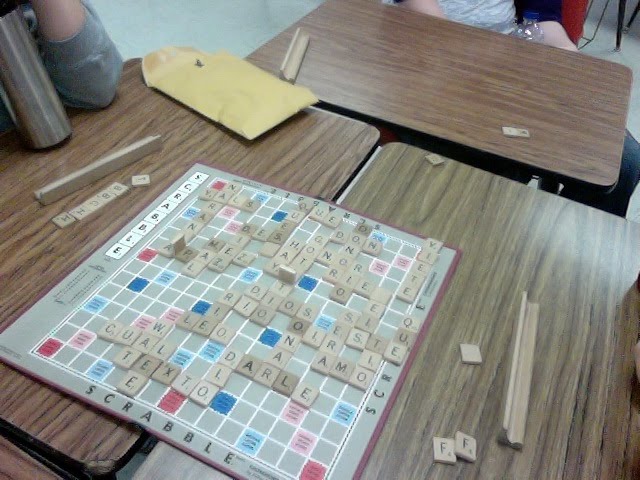
Teaching a World Language is often about building confidence in the language and showing students they CAN speak it. One day last week we had an "off" day. It was to mix things up a bit and to put away the computers. I pulled out some old Scrabble games and the kids created words from their vocabulary base. There was a host of unexpected conversations that took place.
1. What is that word?
2. Is this a word?
3. If I know ____, can I form ____?
4. What words start with/contain W?
5. How many vowels can I use in this word?
6. What was the ___ form of that verb?
7. others...
It was interesting to see some of the words they came up with during the game. There were also unexpected 21st Century Skills they were using in the process.
1. Creative problem solving - they didn't know what word to create or when there wasn't enough room to create the word. You can see one group just started building off the board. Another group put tiles upright to divide words that ran into each other. They also used what they already knew about the language to *ahem* create new words. Some were accurate; some were not, but they were manipulating the language nonetheless. SCORE!
2. Working as a team - if they didn't know what word to use, they would help each other out, not for personal gain, but for the gain of the group.
3. Leadership - They all took on a leadership role in the group at some point during the game. The stronger students helped the weaker students. Encouraging comments were given when a difficult word was accomplished.
4. Collaboration - some groups worked and counseled between groups to create words.
5. Self-directed learners - The teacher didn't have to be right there for them to create new words; they helped each other!
I think we'll do that again someday soon. :) Besides, we all had fun; that's what learning is all about!
Sunday, January 9, 2011
Making Metacognitive Students
Proficient learners are metacognitive, or aware of their own thinking. Teachers model their own learning processes when introducing learning strategies. Students talk and write about learning through process conferences and discussions. When teachers and students share their cognitive secrets, they are more likely to internalize processes. They become more aware of how learning and comprehending takes place. Metacognition is the key to deep understanding of content and the learning process. Lower elementary students to special needs students to gifted students can all be metacognitive beings and unlock the mysteries of learning.
This year I have tried to make my students more metacognitive in their learning by journaling through blogs. Second semester we will return to one-on-one conferencing because it is a powerful strategy that has been put on the back burner this year for my class. I have seen a dip in the learning curve and miss the personal, one-to-one relationship gained with my students during these conferences. Below are some examples of the questions I asked my students to reflect on at the end of each quarter. I encouraged their honesty and openness in their answers. They began to think about their own thinking and learning. Their open and honest answers revealed insights for me as a teacher to help them in selecting learning activities to match their learning style for future lessons. This reinforced what I have always said - students are very "with-it" when it comes to knowing what they need to learn; we just need to ASK them.
Quarter one metacognitive reflective questions:
a. The activities worked best/least to help me learn my vocabulary were.... because...
b. I prefer to work in a group/independently because...
c. I know I am learning when... because... I know I am not learning when I...
d. Based on my learning style, I will change... or I will do ... the same to maximize my learning process.
e. Other information I would like to share with Señora.
Quarter two metacognitive reflective questions:
a. What I did differently or the same this quarter versus last quarter to improve my learning was...
b. As I worked through the activities in class and at home, I realized .... about myself and how I learn.
c. Reading, writing, listening, and speaking are the 4 main skill sets we have been focusing on in learning a world language. My strength is ... My biggest challenge is ... Next semester I will try to ... to improve this skill.
d. Other information I would like to share with Señora.
Thursday, December 9, 2010
Conversación y Café


Today was a great day for South Hamilton Spanish students. Paulino Brener graciously gave an hour of his time to Skype with a packed classroom of students from Spanish II, III, and IV today. My administration willingly allowed them leave their classes and spend some extra time in my classroom to get a real-life, authentic learning experience. Some chose to actively ask and answer questions, while other observed and took notes.
The students prepared questions ahead of time via a Googledoc shared with Paulino. He helped them correct their mistakes in their writing and even chatted with a few who were online at the same time he was. During the Skype session, students asked questions, answered questions, interacted with Paulino via stories, music, and other cultural minilessons.
Adult guests stopped by or stayed for the whole session. Additional discussion followed afterward about how to use additional technology in the classroom.
We can't wait to do this again sometime. There is so much to glean from authentic experiences and we are grateful to have someone so giving to education! Thanks @sr_brener This was all possibly through Twitter!! Check out Paulino's post for this experience: http://bit.ly/fvRUfM
Paulino is also trying to get a $25,000 Pepsi Refresh grant. Please help him out with his project: http://www.refresheverything.com/latinoartminnesota Vote daily through December!
Subscribe to:
Posts (Atom)